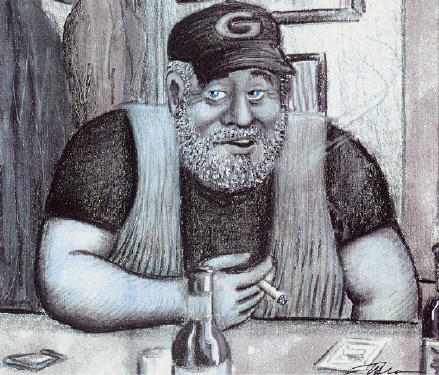
Tuesday, November 22, 2011

The Cheaters

My grandfather, who was born in what was then Manchester, Virginia (in 1893), was a veteran of World War I. The photograph of him below was shot in 1916, when he was in the Richmond Light Infantry Blues. They were then stationed in Brownsville, Texas.

For that duty his unit was converted into a cavalry outfit. He was part of a contingent assigned to protect the border, because Mexican revolutionary/bandit Pancho Villa had supposedly been crossing over to raid small towns.

Later the Blues were thrown into WWI in France; the duty there was considerably more dangerous. The story below is about the best lesson-teacher I've ever known.


Having devoted countless hours to competitive sports and games of all sorts, nothing in that realm is quite as galling to this grizzled scribbler as the cheater’s averted eye of denial, or the practiced tones of his shameless spiel.

In the middle of a pick-up basketball game, or a friendly Frisbee-golf round, too often, my barbed outspokenness over what I have perceived as deliberate cheating has ruffled feathers.

Alas, it's my nature. I can't help it any more than a watchful blue jay can resist dive-bombing an alley cat.

The reader might wonder about whether I'm overcompensating for dishonest aspects of myself, or if I could be dwelling on memories of feeling cheated out of something dear.

OK, fair enough, I don't deny any of that. Still, truth be told, it mostly goes back to a particular afternoon's mischief, gone wrong.

*

A blue-collar architect with the Chesapeake & Ohio Railway for decades, my maternal grandfather, Frank W. Owen was a natural entertainer. Blessed with a resonant baritone/bass voice, he began singing professionally in his teens and continued performing, as a soloist and with barbershop quartets, into his mid-60s.

Shortly after his retirement, at 65, the lifelong grip on good health he had enjoyed failed; an infection he picked up during a routine hernia surgery at a VA hospital nearly killed him. It left him with no sense of touch in his extremities.

Once he got some of his strength back, he found comfort in returning to his role as umpire of the baseball games played in his yard by the neighborhood's boys. He couldn't stand up behind home plate, anymore, but he did alright sitting in the shade of the plum tree, some 25 feet away.

This was the summer he taught me, along with a few of my friends, the fundamentals of poker. To learn the game we didn’t play for real money. Each player got so many poker chips. If his chips ran out, he became a spectator.

The poker professor said he’d never let us beat him, claiming he owed it to the game itself to win if he could, which he always did. Woven throughout his lessons on betting strategy were stories about poker hands and football games from his cavalry days, serving with the Richmond Blues during World War I.

As likely as not, the stories he told would end up underlining points he saw as standards: He challenged us to expose the true coward at the heart of every bully. "Punch him in the nose," he'd chuckle, "and even if you get whipped he'll never bother you again." In team sports, the success of the team trumped all else. Moreover, withholding one’s best effort in any game, no matter the score, was beyond the pale.

Such lazy afternoons came and went so easily that summer there was no way then, at 11, I could have appreciated how precious they would seem looking back on them.

On the other hand, there were occasions he would make it tough on me. Especially when he spotted a boy breaking the yard's rules or playing dirty. It was more than a little embarrassing when he would wave his cane and bellow his rulings. For flagrant violations, or protesting his call too much, he barred the guilty boy from the yard for a day or two.

F. W. Owen’s hard-edged opinions about fair play, and looking directly in the eye at whatever comes along, were not particularly modern. Nor were they always easy for know-it-all adolescent boys to swallow.

Predictably, the day came when a plot was hatched. We decided to see if artful subterfuge could beat him at poker just once. The conspirators practiced in secret for hours, passing cards under the table with bare feet and developing signals. It was accepted that we would not get away with it for long, but to pull it off for a few hands would be pure fun.

Following baseball, with the post-game watermelon consumed, I fetched the cards and chips. Then the four card sharks moved in to put the caper in play.

To our amazement, the plan went off smoothly. After hands of what we saw as sly tricks we went blatant, expecting/needing to get caught, so we could gloat over having tricked the great master.

Later, as he told the boys' favorite story -- the one about a Spanish women who bit him on the arm at a train station in France -- one-eyed jacks tucked between dirty toes were being passed under the table.

Then the joy began to drain out of the adventure rapidly. With semi-secret gestures I called the ruse off. A couple of hands were played with no shenanigans but he ran out of chips, anyway.

Head bowed, he sighed, “Today I can’t win for loosing; you boys are just too good for me.” Utterly dependent on his cane for balance he slowly walked into the shadows toward the back porch. It was agonizing.

The game was over; we were no longer pranksters. We were cheaters.

As he carefully negotiated the steps, my last chance to save the day came and went without a syllable out of me to set the record straight. It was hard to believe that he hadn’t seen what we were doing, but my guilt burned so deeply I didn't wonder enough about that, then.

*

My grandfather didn’t play poker with us again. He went on umpiring, and telling his salty stories afterward over watermelon. We tried playing poker the same way without him, but it didn’t work; the value the chips had magically represented was gone. The boys had outgrown poker without real money on the line.

Although I thought about that afternoon's shame many times before he died nine years later, neither of us ever mentioned it. For my part, when I tried to bring it up, to clear the air, the words always stuck in my throat.

Eventually, I grew to become as intolerant of petty cheating as he was in his day, maybe even more so. And, as it was for him, the blue jay has always been my favorite bird.

-- 30 --

All rights are served by F.T. Rea
1,138 words

Perspective Shapes Meaning

-- SLANTblog 2011

After decades of driving automobiles, mostly small station wagons, over the same city streets, nine years ago your narrator switched to using his then-29-year-old bicycle as his primary ride.


It was quite a change.

At first I was shocked at how soft my legs had gotten. It had been years since I’d done much riding. It was a decision made in summertime. Then the weather began to change. It had been even more years since I had ridden in the dead of winter. Once my legs were in a little better shape, I was reminded again and again of what a great deal that white Azuki ten-speed was when I bought it in 1973 at Dee‘s Bike Shop.

Perched on the Brooks leather saddle, exposed to the elements and staying alert for signs of physical threats, I began to notice things mostly ignored rattling around town in motorized metal boxes on wheels. The perspective I had regained felt good. It was once a view of life I had appreciated quite a bit, so it was like an old friend had come back to town.

As an automobile expands our range, it also seals us off. While time can reveal new truths, in order to see more deeply into selected memories, it seems others must fade away entirely.

After going a full year on the bike I had a confidence in myself that I couldn’t remember having lost, but it was nice to have a measure of it back. Some time after that I came upon an accident involving several vehicles. As I negotiated my way around the debris on Floyd Avenue, near the post office, the sobbing of a young woman caught my attention. She was seated at the wheel of one of the wrecks. Her desperate hands clutched her face.

When I came within a few feet of her mangled small SUV, the sound of utter despair pouring out of her caught me off-guard; her crying pierced my practiced detachment. Although I didn’t know her, for a few seconds my heart raced. If I’d been in a car I probably wouldn’t have seen or heard her.

Pedaling away it dawned on me that it had been a long time since I had been that close to a woman crying inconsolably. Pedaling harder I pushed the haunts that were surfacing back into their storage place.

A few days later riding across a small bridge over the expressway, a car nudged me too close to the railing and I glanced over at the traffic going by under the bridge.

Whoa!

The sense of being up high and uncomfortably close to the drop-off flipped a caution switch in this old goat’s head.

After a deep breath I enjoyed a private laugh at how much I'd changed over the years, with regard to heights. The daredevil boy who had once climbed the WTVR tower for grins had been body-snatched long ago.

Crossing the bridge the bicycle chain churned smoothly, sounding precisely as it always had. I wondered if I’ll ever get too scared to ride my bike across such bridges. Maybe I’ll even be afraid to ride at all, one day, I chuckled. After all, for a good while I’d been too scared to get close enough to a woman to hear her cry.

Now that bicycle is gone. It was stolen yesterday, so my perspective on it has changed. It had outlasted a marriage, three live-in girlfriends and nine motor vehicles.

Upon realizing the bike was missing I felt that familiar numbness creep over me -- the feeling I get when I‘m coping with the news of a death. As I walked around the lower Fan District looking through alleys for the stolen bike, of course I dwelled on favorite memories to do with the departed. I’ll share just one of them:

In the mid-70s I went for a ride in a gentle summer rain, which was not an unusual thing for me to do then. There’s a pretty good chance I had smoked some pot before I took off. As I rode east, away from my Fan District home, the rain came down harder. To complete the picture I was wearing a pair of cut-off jeans and a pair of Converse All-Stars.

The complete scene has remained fresh; I can vividly remember riding fast and fearlessly down the hills on East Franklin Street, just past the Richmond Newspapers building. The rain felt great falling onto my bare skin. As it was a Saturday there were no cars on the road. Flying toward Capitol Square I trusted my bike, absolutely.

Yes, I've thought of that afternoon's wild ride a thousand times. Now, like it or not, my perspective on it has been shifted into a new gear.

-- 30 --

All rights reserved by F.T. Rea
800 words

El-Amin's Bridge to Bitterness

-- Richmond.com 2011

Armed with a piece of the truth, a determined advocate’s argument can sound convincing. That is, as long as that advocate is allowed to shape his audience’s focus and control the context of the dialogue.

Now comes Sa’ad El-Amin to tell Richmonders just whose names ought to be on a bridge over a creek in Forest Hill Park. According to a Richmond Times-Dispatch’s report on Jan. 4, 2011, former city councilman El-Amin sent a letter to City Council calling for names to be added to the official name of the bridge.

The bridge is on public property, it crosses Reedy Creek. On Sept. 20, 2010 it was dedicated as the Harvey Family Memorial Bridge. A bronze plaque with an image of the family, cast in relief, was affixed to a granite stone on the north end of the bridge. Neighborhood civic associations and friends of the Harveys had put together some $2,500 to cover the costs.

In his scolding missive El-Amin said, "Excluding the Tucker family's name on the new bridge was not simply an oversight by City Council, but a blatant act of omission which has clear racial overtones."

In short, El-Amin wants to memorialize nearly all Richmonders slain by convicted murderers Ricky Javon Gray and Ray Joseph Dandridge five years ago.

Out of some sense of charity, El-Amin has said he isn't insisting the Tuckers’ daughter’s name -- Ashley Baskerville -- be included, since she probably acted as a lookout/accomplice for the two murderers of the Harveys.

Some time after Gray and Dandridge set fire to the Harveys’ home in Woodland Heights, Gray and Dandridge finished off Baskerville and her parents in their home in the Swansboro neighborhood. The Tuckers were thought to have played no role in the other murders.

For background on this story go here.

El-Amin decried an element of racism that he has seen in how the local press has treated stories about murder victims, claiming that the stories about black victims don‘t get as much play. No doubt, he has a point -- that piece of the truth. The stain on our landscape from the Jim Crow Era has not yet faded from view.

Hate still exists, but it’s not tolerated in the halls of power like it was in the past.

However, when El-Amin suggested that racism kept the names of black victims off that memorial plaque in the park, he was ignoring the larger view. El-Amin was willfully averting his eye from the specific history that led to the naming of the bridge.

The Harveys, a family of four, were found dead in their home on Jan. 1, 2006. Because the father, Bryan Harvey, 49, was a well known musician, news of his murder was noticed far and wide. Because the mother, Kathy Harvey, 39, ran a popular toy store in Carytown, the story was a sucker punch to her many customers -- lots of local parents.

Because Bryan, Kathy and their two daughters, Stella and Ruby, were murdered in a spectacularly brutal way during a home invasion, reports of the nightmarish news that staggered Richmond’s arts community echoed all over the world.

The Harveys had family and many friends who wanted to create remembrances of them. Money has been raised to establish several memorials to the Harveys; four new seats in the Byrd Theatre will be dedicated to them soon.

Which is especially fitting, because about 1,400 people attended the Harvey Family memorial service at the Byrd Theatre a week after their deaths. A stage full of musicians reminded the grieving audience to remember the Harveys as they were -- folks who loved to laugh. Six months later, at a ceremony at William F. Fox Elementary School, which Stella, 9, had attended, a bench remembering Stella was dedicated. Her classmates released thousands of Painted Lady butterflies as their parents fought back tears.

While it might make us sad to think of it, the other three local victims of that 2006 crime spree were not well known. So there was no widespread outcry to hold a memorial service in a theater’s auditorium. No butterflies were released.

The fact that the Harveys were white and the other victims were black is hardly the main reason the press treated the murders differently in this specific case.

In the wake of the shocking news about murder in Arizona over the weekend, it’s important for leaders, for all of us, to remember to choose our words carefully. Fanning the embers of old hatreds into flames does none of us any good.

For the sake of making the point that the media pays too much attention to the lives and deaths of good looking, talented celebrities, El-Amin seems eager to slather more bitterness over the memory of the Harveys, just to win points in a nonsensical game that only he wants to play.

Enough is enough!

-- 30 --

All rights reserved by F.T. Rea
813 words

Art: What It Is

Jerry Donato (1941-2010) in the Texas-Wisconsin Border Cafe (circa 1985)

-- SLANTblog 2004

In a Richmond, Virginia courtroom in November of 1982 I witnessed an entertaining scene in which an age-old question — what is art? — was hashed out in front of a patient judge named Jose R. Davila. The judge seemed to thoroughly enjoy the parade of exhibits and witnesses the defense attorneys put before him. The room was packed with observers, which included plenty of gypsy musicians, film buffs and art students wearing paint-speckled dungarees.

The defendant in this freedom of speech case was this story’s teller.

When I got charged with a misdemeanor for posting a handbill I had designed that promoted the premiere of a new feature, “Atomic Cafe,” it was a bust I deliberately provoked. At that time I was determined to beat the City of Richmond with a freedom-of-speech defense and knock out the statute prohibiting the posting of flyers on utility poles.

The little poster had been stapled to a pole near the Virginia Commonwealth University campus. Rather than pay the small fine for breaking The City’s law forbidding such advertising in the public way, as the Biograph’s manager, I opted for a day in court. My defense attorneys, Jack Coaln and Stuart Kaplan -- who were also my good friends -- attacked the wording of the statute as “overreaching.”

They asserted on my behalf that it was my right to post the handbill, plus the public had a right to see it. The prosecution called the handbill “litter.”

Beyond the wording of the statute it was easy enough to see the real push behind The City’s crackdown on posting handbills in the Fan District was coming mostly from people who didn’t want rock ‘n’ roll, or alternative cinema, or all sorts of activities close to where they were living.

Thus, my day in court was one little battle in what had been an ongoing culture war in the Fan District in that era. Some of the Fan’s property owners wanted to get rid of much of the commercial activity in the densely populated neighborhood, especially the restaurants/bars.

The expert witnesses/friends who testified to support my case were David Manning White, Phil Trumbo and Jerry Donato. White had been the chairman of VCU's mass communications department. Trumbo was the best known handbill artist in the Fan. Donato was a painting and printmaking professor at VCU.

We also entered into evidence 100 cool handbills by a variety of artists. We contended that when such flyers appeared on key utility poles, in certain shop windows and on selected bulletin boards, they constituted an information system. We said that an aspect of the citizenry didn’t always trust the mainstream media, especially the daily newspapers, so it frequently relied on information delivered by posters made by people they knew.

The judge was reminded that history-wise, handbills predate newspapers. Furthermore, we asserted that the eight-and-a-half-by-eleven, cheaply printed posters were art — a natural byproduct of having a university with a burgeoning art school in the neighborhood.

At a crucial moment, Donato was being grilled by the prosecutor over just where to draw the line between what should be, and what should not be, considered to be genuine art. The Assistant Commonwealth’s Attorney, William B. Bray, asked the witness if the humble piece of paper in his hand, the offending handbill, could actually be “art.”

“Probably,” shrugged the prof. “Why not?”

The stubborn prosecutor grumbled, reasserting that it was no better than trash in the gutter.

Eventually, having grown weary of the artsy, high-brow vernacular being slung around by the witnesses, the prosecutor tried one last time to make Donato look foolish.

As Warhol’s soup cans had just been mentioned by the art expert, the prosecutor asked something like, “If you were in an alley and happened upon a pile of debris spilled out from a tipped-over trashcan, could that be art, too?”

“Well,” said the artist, pausing momentarily, Jack Benny-like for effect, “that would depend on who tipped the can over.”

Donato’s punch line was perfectly delivered. The courtroom erupted into laughter. Even the judge had to fight off a smile.

The crestfallen prosecutor gave up. The City lost the case. Although I got a kick out of the crack, too, I’ve always thought The City’s mouthpiece missed an opportunity to hit the ball back across the net.

“Sir, let me get this right,” he might have said, “are you saying the difference between art and randomly-strewn garbage is simply a matter of whose hand touched it; that the actual appearance of the objects, taken as a whole, is not the true test? Would you have us believe that without credentials, such as yours, one is ill-equipped to determine the difference ordinary trash and fine art?”

A smarter lawyer could well have exploited that angle.

Still, the prosecutor’s premise/strategy that an expert witness could be compelled to rise up to brand a handbill for a movie, a green piece of paper with black ink on it, as “un-art” was absurd. So, Donato, who was a wily artist if there ever was one, probably would have one-upped the buttoned-down lawyer, no matter what.

Perhaps the question shouldn’t have been — how can you tell fake art from real art? After all, any town is full of bad art, mediocre art and good art. Name your poison.

The better question to ask is whether the art is worthwhile or useful. Then you become the expert witness. However, when it comes to great art, it still depends on who tips the can over.

-- 30 --

All rights reserved by F.T. Rea
923 words

Wednesday, August 17, 2011

Living in the Moment

Originally published by SLANTblog in 2005

The blistering heat added to the growing sense in the air that anything could happen. Before the program of speakers and singers began, as the burgeoning crowd was being funneled into the grassy ellipse south of the White House — the designated demonstration area — the morning’s temperature had already reached the upper 90s.

It was Sat., May 9, 1970.

Five days earlier four students had been shot to death by members of the Ohio National Guard on the Kent State University campus during a Vietnam War protest rally; three days later two more students were killed at Jackson State.

The White House grounds and Lafayette Park were surrounded by DC transit system buses, parked snugly end-to-end. Cops in riot gear were stationed inside the bus-wall perimeter every few yards.

Estimates ranged widely but most reports characterized the size of the crowd at well over 100,000. Home-made signs were everywhere, including a sprinkling of placards that denounced the mostly young war protesters. The smell of burning pot gave the gathering a Rock ‘n’ Roll festival feel, too.

Unlike the other large anti-war demonstrations of that era, which were planned for months, this time it all fell together spontaneously. People who had never marched in protest or support of anything before had been moved to drop what they were doing, to set out for Washington, D.C. — to live in the moment.

As a convoy of military vehicles drove into the park area many in the crowd booed. When it turned out the uniformed troops were bringing in bottled water for the thirsty, the booing stopped. Dehydration was a problem that cloudless day.

After the last speaker’s presentation the ever-present police stood by watching thousands of citizens spill out of the park area, to stretch a line of humanity all the way around the wall of buses. The idea was that whether he liked it or not President Richard Nixon, who stayed inside the White House, would hear the crowd’s anti-war chants.

The demonstration flowed north, then west, from one block to the next. Long lenses peered down from the roofs of those distinctively squat DeeCee buildings. An untold number of fully-equipped soldiers were crammed into basements, visible in the doorways, awaiting further orders. Many of them must have been scared they might be ordered to fire upon their fellow Americans.

Hippies who had been wading in a fountain to cool off scaled a statue to get a better look. A few minutes later a cheer went up because a determined kid had managed to get on top of a bus to wave a Viet Cong flag. When the cops hauled the flag-waving disposable hero off, a commotion ensued.

Soon the scent of tear gas spiced the air. This story’s teller was making a record of what he saw with his new 35 mm single lens reflex.

The next day I was back in Richmond for yet another gathering of my generation. Staged in Monroe Park, Cool-Aid Sunday featured plenty of live music. Information booths and displays were set up by the Fan Free Clinic, Jewish Family Services, Rubicon (a dry-out clinic for drug-users), the local Voter Registrar’s office, Planned Parenthood, Crossroads Coffeehouse, etc.

Although it was not a political rally the crowd assembled in Monroe Park, while much smaller, was similar in its look to the one the day before in Washington.

As I remember it, there were no reports about anyone being seriously injured at Saturday’s tense anti-war demonstration. Then, ironically, a 17-year-old boy — Wilmer Curtis Donivan Jr. — was killed on Sunday in the park in Richmond, when a four-tier cast iron fountain he had scaled suddenly toppled.

The photograph of Donivan falling to his death that ran on the front page of the Richmond Times-Dispatch on the next day (May 11, 1970) is one I’ll never forget.

No doubt, the convergence of strong feelings from the extraordinary week that had preceded Cool-Aid Sunday had set the scene. Shortly before Donivan fell, I remember seeing him on the fountain, seemingly caught up in much the same spirit as the hippies climbing on statues the day before.

Without that week’s unique momentum Donivan probably wouldn’t have felt quite so moved to demonstrate his conquest of that fountain. Witnesses said he was rocking it back and forth, just before it crumbled.

The way that Sunday afternoon’s be-in ended was burned into the memory of hundreds of Richmonders who were gathered in Monroe Park to peacefully celebrate being young and alive.

Forty years ago, this week, the USA was becoming ever more bitterly divided over the Vietnam War. Every night on the televised news the death counts were announced. It was a time in which living in the moment was killing off the young and unlucky … wherever they were.

-- 30 --

The Big Stretch


This piece was first published by STYLE Weekly in 2002.

The prototype was assembled during a lull in seventh grade shop class. After tying some 15 rubber bands together to make a chain, a collaborator held one end of the contraption as I stepped back to stretch it out for a test. Squinting to sight along the taut line to take proper aim, finally, I let go.

The whole thing gathered itself and shot past the holder. The released tip smartly struck a target several feet beyond the holder. While the satisfaction I felt was a rush, the encouragement from the boys who witnessed that launching felt transforming.

Through a pleasant sequence of trial-and-error experiments, it was soon determined how to best maximize distance and accuracy. Once guys across the room were getting popped with the bitter end of my brainchild -- dubbed The Stretch -- the spitballs that routinely flew around classrooms in 1960 at Albert H. Hill Junior High -- were strictly old news.

The following morning, uncharacteristically, I appeared on the schoolyard an hour before the first bell. Inside a brown paper bag I had with me an updated version of the previous day’s invention. This one was some 60 links long -- the Big Stretch.

Once it was tested on the schoolyard, demonstrating its amazing new range, boys were soon shoving one another aside just to act as holders. Most of the time I did the shooting. Occasionally, one of the guys from my inner circle was permitted to be the shooter. As the wonder whizzed by it made such a splendid noise that just standing close by the holder was a thrill, too. On the asphalt playground behind the yellow brick school building an enthusiastic throng cheered each flight.

The Big Stretch went on to make an appearance at an afternoon football game, where its operators established to the delight of the audience that cheerleaders on the sideline at a football game could be zapped on their bouncing butts with impunity from more than 25 yards away. After a couple of days of demonstrations around the neighborhood and at Willow Lawn shopping center, again, I significantly lengthened the chain of rubber bands.

But the new version -- about 100 rubber bands long -- proved too heavy for its own good. It was not as accurate or powerful as the previous model. Then came the morning a couple of beefy ninth-grade football players weren’t content with taking a single turn with the new Big Stretch. Although there was a line behind them they demanded another go.

Surrounded by seventh-grade devotees of the Big Stretch, I stood my ground and refused. But my fair-weather-friend entourage was useless in a pinch. Faced with no good options, I fled with my claim-to-fame in hand. In short order I was cornered and pounded until the determined thieves got the loot they wanted. They fooled around for a while trying to hit their buddies with it. Eventually, several rubber bands broke and the Big Stretch was literally pulled to pieces and scattered.

By then my nose had stopped bleeding, so I gathered my dignity and shrugged off the whole affair, as best I could. I choose not to make another version of the Big Stretch. A couple of other kids copied it, but nobody seemed to care. Just as abruptly as it had gotten underway, the connected-rubber-band craze ran out of gas at Hill School.

It was over.

At that time the slang meaning of “cool” had an underground cachet which has been stretched out of shape since. We’re told the concept of cool, and the term itself, seeped out of the early bebop scene in Manhattan in the ‘40s. That may be, but to me the same delightful sense of spontaneity and understated defiance seems abundantly evident in forms of expression that predate the Dizzy Gillespie/Thelonious Monk era at Minton’s, on 118th Street.

Wasn’t that Round Table scene at the Algonquin Hotel, back in the ‘20s, something akin to cool? If Dorothy Parker wasn’t cool, who the hell was? And, in the decades that preceded the advent of bebop jazz, surely modern art -- with its cubism, surrealism, constructivism, and so forth -- was laying down some of the rules for what became known as cool.

Cool’s zenith had probably been passed by the time I became enamored with the Beats, via national magazines. Widespread exposure and cool were more or less incompatible. Significantly, cool -- with its ability to be flippant and profound in the same gesture -- rose and fell without the encouragement of the ruling class. Underdogs invented cool out of thin air. It was a style that was beyond what money could buy.

The artful grasping of a moment’s unique truth was cool. However, just as the one-time-only perfect notes blown in a jam session can’t be duplicated, authentic cool was difficult to harness; even more difficult to mass-produce.

By the ‘70s, the mobs of Hippies attuned to stadium Rock ‘n’ Roll shrugged nothing off. Cool was probably too subtle for them to appreciate. The Disco craze ignored cool. Punk Rockers searched for it in all the wrong places, then caught a buzz and gave up.

Eventually, in targeting self-absorbed Baby Boomers as a market, Madison Avenue promoted everything under the sun -- including schmaltz, and worse -- as cool. The expression subsequently lost its moorings and dissolved into the soup of mainstream vernacular. Time tends to stretch slang expressions thin as they are assimilated; pronunciations and definitions come and go.

Since then people say, “ku-ul,” simply to express ordinary approval of routine things.

The process of becoming cool, then popular, pulled the Big Stretch to pieces. Once the experimental aspect of it was over it got old, like any worn out joke. Then it began to play as just another showoff gimmick, which was something less-than-cool, even to seventh-graders a long time ago.

Cool was illusive by its nature. Fresh could be cool; stale was frequently uncool. More importantly, in that time being a copycat was never cool.

-- 30 --

Friday, August 05, 2011

Perspective Shapes Meaning

After decades of driving automobiles, mostly small station wagons, over the same city streets, nine years ago your narrator switched to using his then-29-year-old bicycle as his primary ride.


It was quite a change.

At first I was shocked at how soft my legs had gotten. It had been years since I’d done much riding. It was a decision made in summertime. Then the weather began to change. It had been even more years since I had ridden in the dead of winter. Once my legs were in a little better shape, I was reminded again and again of what a great deal that white Azuki ten-speed was when I bought it in 1973 at Dee‘s Bike Shop.

Perched on the Brooks leather saddle, exposed to the elements and staying alert for signs of physical threats, I began to notice things mostly ignored rattling around town in motorized metal boxes on wheels. The perspective I had regained felt good. It was once a view of life I had appreciated quite a bit, so it was like an old friend had come back to town.

As an automobile expands our range, it also seals us off. While time can reveal new truths, in order to see more deeply into selected memories, it seems others must fade away entirely.

After going a full year on the bike I had a confidence in myself that I couldn’t remember having lost, but it was nice to have a measure of it back. Some time after that I came upon an accident involving several vehicles. As I negotiated my way around the debris on Floyd Avenue, near the post office, the sobbing of a young woman caught my attention. She was seated at the wheel of one of the wrecks. Her desperate hands clutched her face.

When I came within a few feet of her mangled small SUV, the sound of utter despair pouring out of her caught me off-guard; her crying pierced my practiced detachment. Although I didn’t know her, for a few seconds my heart raced. If I’d been in a car I probably wouldn’t have seen or heard her.

Pedaling away it dawned on me that it had been a long time since I had been that close to a woman crying inconsolably. Pedaling harder I pushed the haunts that were surfacing back into their storage place.

A few days later riding across a small bridge over the expressway, a car nudged me too close to the railing and I glanced over at the traffic going by under the bridge.

Whoa!

The sense of being up high and uncomfortably close to the drop-off flipped a caution switch in this old goat’s head.

After a deep breath I enjoyed a private laugh at how much I'd changed over the years, with regard to heights. The daredevil boy who had once climbed the WTVR tower for grins had been body-snatched long ago.

Crossing the bridge the bicycle chain churned smoothly, sounding precisely as it always had. I wondered if I’ll ever get too scared to ride my bike across such bridges. Maybe I’ll even be afraid to ride at all, one day, I chuckled. After all, for a good while I’d been too scared to get close enough to a woman to hear her cry.

Now that bicycle is gone. It was stolen yesterday, so my perspective on it has changed. It had outlasted a marriage, three live-in girlfriends and nine motor vehicles.

Upon realizing the bike was missing I felt that familiar numbness creep over me -- the feeling I get when I‘m coping with the news of a death. As I walked around the lower Fan District looking through alleys for the stolen bike, of course I dwelled on favorite memories to do with the departed. I’ll share just one of them:

In the mid-70s I went for a ride in a gentle summer rain, which was not an unusual thing for me to do then. There’s a pretty good chance I had smoked some pot before I took off. As I rode east, away from my Fan District home, the rain came down harder. To complete the picture I was wearing a pair of cut-off jeans and a pair of Converse All-Stars.

The complete scene has remained fresh; I can vividly remember riding fast and fearlessly down the hills on East Franklin Street, just past the Richmond Newspapers building. The rain felt great falling onto my bare skin. As it was a Saturday there were no cars on the road. Flying toward Capitol Square I trusted my bike, absolutely.

Yes, I've thought of that afternoon's wild ride a thousand times. Now, like it or not, my perspective on it has been shifted into a new gear.

-- 30 --


Tuesday, October 05, 2010

Fan District Bar Obits

Originally published by Richmond.com in the years indicated

Texas-Wisconsin Border Café
(1999)

In 1982 three adventurous friends trusted their instincts and put together the Texas-Wisconsin Border Café, a quirky Fan District watering hole known affectionately as “The Border.”


Owners Jim Bradford (depicted above), Donna Van Winkle and Joe Seipel were rewarded with an immediate following. It evolved into an institution known widely for its wacky interior and its diverse crowd; a place where blue collars, white collars and no collars got along famously.

When word got out in early March the Border was being sold, old customers and ex-staffers began making pilgrimages to the place for one last drink, one last connection to a piece of their youth. Although it had been rumored the Border was for sale for some time, what isn’t these days?

When Bradford -- a tireless photo-realistic painter with a curmudgeon’s sense of humor -- died in the summer of 1997, well, the future of the restaurant became much more complicated. Of the three owners, Jim had surely been the one who spent the most time bellied up to the bar, overseeing operations.

After managing the restaurant in its salad days, Van Winkle had gone to law school, become an attorney, and moved to Fredericksburg. Fifty miles is a tough commute for a late-afternoon beer.

That left Seipel, chairman of VCU’s sculpture department, to hold down the happy hour fort in the section of the restaurant known as the Power Corner. Although Seipel’s talent for convivial conversation is considerable, he had taken on time-consuming responsibilities over the years; fatherhood not the least of them.

So, it was time to turn the page. On March 14, the last night of the original ownership’s watch, a bagpiper played “Amazing Grace” to close the Border down. After playing a while for the crowd on hand he marched out the door, bagpipes caterwauling passionately, and it was done.

The scene brought to mind filmmaker Luis Bunuel’s apt comment in his autobiography, My Last Sigh, about a good bar being like a chapel. No doubt, most who were there for the piper’s last mournful note took with them a strong sense of that sentiment.

Then new owners decided to honor a date the old owners had made with Burnt Taters for a March 26 CD release party. That meant keeping the business open under the old banner for a few more days and putting off the renovations. As it turned out, the delay set the stage for quite a finale.

What followed was an auction event on the actual last night of operation as the Texas-Wisconsin Border Café. At six o’clock Page Wilson and Reckless Abandon gave the makeshift stage in the front of the room over to the selling off of the bar’s wild and eclectic collection of wall decorations and art-like objects. They pulled down the framed pictures, the stuffed animal heads, the signs, and you name it. What went on was part wake, part fund-raiser, part souvenir-grab and all party.

The bidding at times resembled a feeding frenzy, as people climbed over one another to throw three figures at stuff, some of which wouldn't go for five bucks at a yard sale. The crowd cheered as each bid drove the price higher.

One rather attractive young woman gladly paid hundreds of dollars for a stuffed squirrel’s butt. A roar went up as she outbid her rivals and everyone ordered another round. The more absurd the prices got the more fun was being had. Since the money raised from the auction all went to the Bradford Scholarship Fund at VCU, more than $10,000, the harm couldn’t be found.

The Border, a happening unique in an age of conformity, will be missed. Don’t expect it to happen again.

*

Soble’s
(2000)

Soble’s, home of “the world-famous bacon cheeseburger” for 22 years, is no more.

Paul Soble and his partner, Bruce Behrman, have sold the well-known Fan District restaurant to a group that plans to open a new restaurant under the name, “The Devil’s Kitchen.”

Soble’s, Part One, lasted ten years (1977-87) at 2526 Floyd Avenue in what had previously been the location of Cavedo’s, a traditional neighborhood drug store with a classic soda fountain. Part Two saw the restaurant lose its lease, pack up its patio, and move one block to the south - 2600 West Main Street.

Soble’s had a feel to it that was reminiscent of traditional watering holes in large cities on the eastern seaboard. Its elegant back bar was cluttered with memorabilia that included hundreds of photos of regulars and popular culture souvenirs that documented a generation’s after-dark highlights and next-day hangovers.

The mirrors were covered with Elvis kitsch, dog-eared tickets from NRBQ concerts, High on the Hog backstage passes, postcards featuring shapely derrieres, and silly bumper stickers with slogans such as, “bad cop - no doughnut.”

Perhaps the peak of Soble’s popularity was in the mid-‘80s, when an every-other-Monday jam session evolved into a scene that had a touch of magic. It came to be known as the “Blue Monday Jam.”

As the summer of 1986 wore on, the crowds for the impromptu show began to fill the restaurant and overflow onto the patio and into Floyd Avenue. Jimmy Maddox, a vocalist who accompanied himself on piano, served as organizer and host for shows that included the best musicians in town on a given Monday.

Other clubs tried to copy the concept and attempted to set up nights for jam sessions. None of them were ever able to duplicate the scene that naturally formed in Soble’s.

Behrman confirmed that indeed he saw the Blue Monday Jam as a high water mark in popularity for the restaurant. But he laughed at the idea that the live music crowds of those Monday nights spent a lot of money.

Still, that rowdy scene was part of why Soble’s became a headquarters for a certain ilk. It now joins the Texas-Wisconsin Border Café and John & Norman’s as noteworthy Fan District restaurants to cash in their chips within the last year.

According to Vaughn Turner, a bartender for many years at the Border, the Devil’s Kitchen will serve a bacon cheeseburger of sorts. He also indicated that hot sauces, made on the premises, will be featured in the new operation. Turner is one of three partners involved in the venture.

While there to check out the changes underway, I looked for a bullet hole in the back bar that had been put there during a 1987 holdup, shortly after the move from Floyd to Main. One of the robbers fired a shot at Soble that he was purported to have dodged. I couldn’t find the hole; somebody must have fixed it. It’s hard to imagine Paul ever moving that fast again.

Perhaps it was time to make a change. As far as why he and Soble sold the business, Behrman said, “We both got tired of it and wanted to do some other things. Business was okay.”

Soble’s is on a short list of restaurants that gets, or deserves, an obituary.

Note: Paul Soble died on July 27, 2000.

*

Chiocca’s Park Avenue Inn
(2004)

On Monday, Frank Chiocca stood tending bar for his last shift. As he answered a question from a customer the phone rang; another old friend was calling to pay his respects. With the sun setting on what was a crisp autumn day Chiocca was reflective, yet upbeat, in the midst of his familiar five o'clock crowd for the last time.

Chiocca's Park Avenue Inn opened for business on June 18, 1964. It closed for good on November 29, 2004.

According to Chiocca a 1964 bottle of Richbrau, which was then brewed and bottled about a half-mile from his Fan District location, cost a quarter. He chuckled, "Forty years! I didn't have two nickels to rub together when I got here."

To say Frank Chiocca, 79, has the food-and-drink biz in his blood is a bit of an understatement. After returning to Richmond from service in the Italian army during World War I, his father, Pietro Chiocca -- whose two older brothers were already running a restaurant at 812 W. Broad Street called Jimmy's -- became a partner in Silvio Funai's restaurant. The building at 327 E. Franklin St., which no longer exists, had previously been a public library. In 1937 "Pete" Chiocca bought Funai out and renamed the place Chiocca and Son.

Before they left to serve in the American armed forces during World War II, Pete's boys -- Andrew, Joe, Mario and Frank -- all worked in his restaurant, which was across the street from the Richmond Newspapers building.

In 1947 Joe opened his own eatery at 2915 W. Cary St. (in the building that now houses The Track); he called it Chiocca's. In 1952 brother Mario followed suit by opening his version of a Chiocca's at 425 Belmont Ave. His children, Tim and Carla, still operate that basement tavern today, in much the manner it has always been run.

In 1961 Pete Chiocca closed the original downtown Chiocca's. Using the typewriter with which he had created the daily menus for years, Frank then put together a few recollections of his father's place to help columnist Charles McDowell with a piece he wrote paying tribute to the passing of a favorite haunt. According to McDowell's account, Frank's history recalled, "... the prohibition days, the bawdy girls who would occasionally saunter in to catch the eye of a medical student, a lawyer, an artist, musician, and perhaps even a newspaper man. ...and the ever-present gas pilot light at face level near the tobacco case, for lighting one's cigar or cigarette."

Chiocca's Park Avenue Inn was known for its time-capsule atmosphere and its made-to-order sandwiches; the signature sandwich was called "the Masterpiece." It featured an anchovy sauce based on Frank's mother's recipe. Watching his hands carefully constructing a sandwich and arranging the presentation on the plate was always worth studying; he was a polished craftsman.

In recent years his shrinking customer base was made up mostly of young families from the surrounding blocks who eschewed fast food, and graying beer aficionados who grew up in that same area. Now those loyal customers have lost an authentic connection to a sepia-toned time when the Fan District was dotted with Ma and Pa restaurants and small markets.

Moreover, the list of forgettable dives and pretentious hash houses that have come and gone in the Fan during Frank Chiocca's steady 40-year-run is too long for this limited space.

“All things come to an end,” Chiocca shrugged. “Forty years; it’s been a good run.”

-- 30 --

On Libby Hill

Originally published by Brick Weekly in 2007

High on the Hog 1977-2006


Due to the intrusion of an all-day downpour, last year’s edition of High on the Hog, No. 30, was a soggy affair. Two of the bands scheduled couldn’t play under the circumstances. Yet, in spite of the stormy weather, the Bopcats and the Memphis Rockabilly Band performed using a scaled down sound system. Tarps were lashed to the sides and back of the stage to block the wind-driven rain.

A few party stalwarts danced in the mud with umbrellas. The show went on … but perhaps for the last time.

“It was a Nor’easterner that settled over Richmond,” said the longtime director of matters musical, Chuck Wrenn. “We’ll see what the future brings.”

Meanwhile, there certainly will be no High on the Hog 31 this year.

So, the director of matters porcine, Larry Ham, won’t be slathering his Carolina red vinegar basting sauce over slow-cooking pork this Saturday in Libby Hill Park. Moreover, it seems likely that High on the Hog—which for three decades has served a generation as a reliable reunion party—has probably happened for the last time.

The heavy losses sustained from last year’s fizzler meant the handful of friends/neighbors who have staged and financially backed HOTH since its inception took a bath in red ink ... the rainy day fund was wiped out.

Going back to HOTH’s origins, other than Ham, among Wrenn’s chief co-conspirators have been: Bobby Long, Dave O’Kelly, John Cochran, Randy Smith and Steve McKay. For such veterans last year’s weather had to bring to mind another rainy day, 26 years before. 1980 was the year they significantly enlarged the plan for what had originally been a small annual neighborhood party.

Three rousing rock n’ roll bands played on a flatbed trailer in the cobblestone alley behind Wrenn’s 2808 East Franklin Street back yard for what was the then-largest HOTH crowd ever.

Yet, this was a time when one couldn’t get a permit from the proper authorities for such an event. Amplified rock simply wasn’t allowed at outdoor shindigs in Richmond, most especially on public property. So, in a sense HOTH 4 was flying below, or perhaps above, the radar. For whatever reason the cops on the beat chose not to bust it.

When it suddenly began raining in 1980, rather than lose momentum by shutting off the electricity and clearing the stage—to wait out the downpour—Wrenn broke out his staple gun and large rolls of heavy-gauge transparent plastic. With the help of volunteers an awning was hastily improvised to keep the rain off the stage. A portion of the yard closest to it was also protected, somewhat.

Then, with the electric guitars of Don’ Ax Me ... Bitch wailing in defiance of the chilly rainstorm, the sense of common purpose felt by those dancing in the mud was unforgettable. The full potential of live rock n’ roll music to simultaneously express both lamentation and celebration was realized.

In 1983 HOTH had outgrown its alley venue, so it shifted gears and moved into the park across the street. The throwdown even went legit. Subsequently, HOTH’s rollicking success and noteworthy lack of trouble planted the seeds for Jumpin’ in July, Friday Cheers and the outdoor music festivals that have blossomed since.

The HOTH record for beer sales on a Saturday afternoon still stands at 209 kegs; it was some time in the early ‘90s, according to Chuck. At its peak, it took some 350 volunteers to chop the pork, serve the beer, tend the stage, etc. Each year volunteers got a new HOTH T-shirt for their trouble; extras were sold to the public. There have been 25 different models.

What was a beloved local gospel group, The Silver Stars, holds the record for most HOTH appearances with 10 (1987-‘96). The Memphis Rockabilly Band played the gig seven times (1980, ‘81, ‘84-‘87, ‘06).

“The Silver Stars, we got every year we could ... until they died,” Wrenn recalled.

What were locally-based bands with multiple appearances include: The Bopcats, The Good Humor Band, Billy Ray Hatley’s bands, Page Wilson with Reckless Abandon and The Wall-O-Matics. Maybe the three most noteworthy national acts were: Billy Price and the Keystone Rhythm Band in ‘83 and ‘85; NRBQ in ‘87; Marcia Ball in ‘01.

Presented with the prospect that HOTH has run it course, a smiling Chuck Wrenn offered familiar advice, “Don’t forget to have a good time.”

Those coveted laminated backstage credentials, which meant free beer to the wearer, will probably be selling on eBay soon. Who knows what T-shirts will eventually be worth?

Appropriately, as it stands now, the last band to perform was the impeccably authentic Memphis Rockabilly Band. Although it was unplanned, they were the perfect act to play an encore for 30 years of smiles ... one last fast dance in the mud.

*

Originally published by Richmond.com in 2009

This View Is Our View


As I was walkin' - I saw a sign there
And that sign said - no tress passin'
But on the other side ... it didn't say nothin!
Now that side was made for you and me!

-- From Woody Guthrie's "This Land Is Your Land"


For a generation of music-loving Richmonders the second Saturday in October always meant another edition of High on the Hog -- the annual outdoor, pork-worshipping party staged in Libby Hill Park. The last of those rock ‘n’ roll themed parties was in 2006.

Over the 30 years of HOTHs, which functioned as reunions for regular attendees, some number of them must have paused over their barbeque sandwiches to appreciate Libby Hill Park’s famous elevated view of the James River winding away from Downtown Richmond toward the Chesapeake Bay.

Countless celebrations and festivities have taken place in that public park since its original days of being named Marshall Square, after Supreme Court Chief Justice John Marshall. Following the Civil War the name was changed to Libby Hill Park, after Luther Libby who lived adjacent to the park. Libby is remembered by history buffs for his nearby warehouse that was used by the Confederacy as prison during the Civil War.

Speaking of history, the story goes that in the 1700s the look of the James from what is now Libby Hill Park was so reminiscent of a similar view of the Thames in Richmond, England that Virginia’s capital city got its name from that resemblance.

With its 115-year-old Soldiers and Sailors Monument, rolling hills and quaint park house, Libby Hill Park has been the setting for countless picnic lunches and moonlit strolls. Tourist buses drive to the park religiously.

It’s all about The View.

Chuck Wrenn, the impresario who booked the entertainment for the HOTH parties, lives with his wife and two daughters on East Franklin Street, facing the park. “I was married in that park,” he said.

No doubt, many others are carrying memories of a special moment associated with the same vista.

HOTH parties, Frisbee-golf games and inner tube rides down snow-covered slopes aside, my own most vivid recollection of that park comes from a late afternoon with a girlfriend. In the early-1980s, for the benefit of my zoomed-in Super 8 lens, she was doing cartwheels, landing smoothly on her hands, then feet, then hands. As I panned to follow her, my camera angle had the shimmering light on the river in the background.

“This view belongs, not only to near-by residents, but to tourists and visitors from around the world,” said Tom Layman, who also lives close to the park.

Yes, the good folks who live in the houses closest to the park, like Chuck and Tom, have been happily sharing The View with the rest of us, all along.

Will that change soon?

Will a proposed condominium and hotel development, Echo Harbour, eventually be interposed between Libby Hill Park and the James River? Will old postcards, wedding photos and Super 8 clips be all that preserves The View for future generations to appreciate?

USP Rocketts LLC owns the land on which the proposed $160 million mixed-use project would be built on the riverfront. USP Rocketts LLC is based in Falls Church. Interestingly, it is a development company owned by the Unification Church founded by Sun Myung Moon.

The Unification Church also owns the Washington Times and a sprawling array of properties, nonprofit foundations and for-profit holding companies. Its worldwide holdings are vast and somewhat mysterious. Over the years, through various channels Moon’s money has been quite helpful to ultra conservative causes and politicians in America.

The City of Richmond’s plan for the site where the condos and such would go doesn’t call for buildings 10 to 14 stories tall. Current zoning doesn’t allow for such buildings. So, USP Rocketts needs the City to change its collective mind about what ought to happen on Dock Street.

A campaign to convince City Council to give USP Rocketts what it wants has been underway. The developers have pointed at the money Richmond should rake in from new tax revenues. They’ve talked about the jobs their project will create. There’s nothing new about that tactic. True or false, all developers sing that same basic tune when they want special favors from governments.

It’s then up to the government, in this case City Council, to decide what is the greater good.

If the City allowed a hog farm to be established where the GRTC bus barns are now that would create jobs, too. No doubt, the promoters of such a ridiculous notion could blue sky the story of how the hog farm would impact the neighborhood.

Ken Burns’ newest PBS documentary, “The National Parks: America’s Best Idea,” tells the story of how the USA wisely saw fit to protect some of its most beautiful views. Beginning with Yellowstone National Park, in 1872, America led the world in establishing parks owned by rich and poor citizens, alike, and protected by the government.

Isn’t Richmond looking at the same sort of problem America faced when it opted to establish national parks, rather than let hard-charging developers build whatever they liked and put up no trespassing signs?

Boiled down to its essence, it’s a choice: Should Richmonders go on preserving a cherished view of the James River that benefits the entire community? Or, should we stuff more money into the Unification Church’s coffers, hoping a few bucks fall our way?

Wasn’t this spectacular view of our river made for you and me?

-- 30 --

From Yeats to Greene to Stone

Turning and turning in the widening gyre
The falcon cannot hear the falconer;
Things fall apart; the centre cannot hold;
Mere anarchy is loosed upon the world


-- From “The Second Coming”
by William Butler Yeats

Revved up over an English class assignment to write a paper on "The Second Coming," by W. B. Yeats, I stayed up all night crafting it, and thought I had hit a home run. The professor, an awkward, gangly sort of fellow in his late-20s, gave me a “C” on it.

Well, I just had to ask him to explain to me what was wrong with the paper. In a private conference he told me my analysis of the poem didn't jibe with the accepted school of thought on what Yeats was saying. While admitting my writing and analytical technique were fine, he nervously explained that I was simply wrong in my conclusions, no matter how well-stated my case might have been.

That sort of pissed me off, so I told him I thought that ambiguity could imply multiple meanings, and it deliberately invited alternative interpretations. Rather than defend as his stance the man suddenly grabbed his face and broke into tears.

The sobbing professor went into a monologue on the shambles his life had fallen into. His personal life! Worst of all, he said, his deferral had just been denied by Selective Service, so he would soon be drafted.

He was wearing a pitiful brown suit. His thinning beige hair was oiled flat against his scalp. My anger over the bad grade turned into disgust from his out-of-control behavior. As I remember it, I walked out of his office to keep from telling him what I thought.

Now, over four decades later, I regret my impatience and feel sorry for the poor schlemiel. Still, when the offer came at the end of the semester to expand my part-time job to full-time, I took the leap. My chief duty was to schlep visiting scholars around Virginia from one university campus to the next in a big black Lincoln.

Each week, under the auspices of the University Center in Virginia -- a consortium of Virginia colleges and universities -- there was a new scholar in a different field. Somebody had to drive them to lectures, dinners, convocations and to hotels throughout the week. For one whole semester that was me.

Naturally, in the crisscrossing of Virginia, the wiseguy driver and the actually wise scholars had a lot of time to talk. Some of them kept to themselves, mostly. Others were quite chatty, in several cases we got along well and had great talks.

Three of them stand out as having been the best company on the road: Daniel Callahan (then-writer/editor at Commonweal Magazine), Henry D. Aiken (writer/philosophy professor) and Balcomb Greene (artist/philosopher and art history professor).

Callahan challenged me to think more thoroughly about situational ethics and morality. He was happy I was reading the books of Herman Hesse and others. He turned me on to “One Dimensional Man,” by Herbert Marcuse.

Callahan was quite curious about my experiences taking LSD, we talked about drugs and religion.

Aiken (1912-‘82) was then the chairman of the philosophy department at Brandeis University, he loved a debate. He was used to holding his own against the likes of William F. Buckley. Talking with him about everything under the sun in the wee hours, I first acquired a taste for good Scotch whiskey.
From a ‘pragmatic’ point of view, political philosophy is a monster, and whenever it has been taken seriously, the consequence, almost invariably, has been revolution, war, and eventually, the police state.

-- Henry D. Aiken
Aiken, like Callahan, agreed to help me with a project I told them about. Inspired by popular new magazines Ramparts, Avant-Garde, Rolling Stone, etc. -- at 21-years-old -- I wanted to jump straight into magazine publishing, with no experience, ASAP.

That dream stayed on the back burner for 16 years, until the first issue of SLANT came out in 1985. However, the biggest influence on the way I went about publishing SLANT flowed from my association with Greene (1904-90). He was, by far, the rent-a-scholar who was the funniest and the one who had the biggest influence on me.

The son of a Methodist minister, Greene grew up in small towns in the Midwest. He studied philosophy at Syracuse University, psychology at the University of Vienna and English at Columbia University. Then he switched to art, having been influenced by his first wife, Gertrude Glass, an artist he had married in 1926. He became a founder of the avant-garde group known as American Abstract Artists in 1936.

After World War II, just as abstract art was gaining acceptance, Greene radically changed his style. He began painting in a more figurative, yet dreamy, style that fractured time. As a mentor/professor, his most famous student was Andy Warhol.

One day I’ll write a piece about the visit to Sweetbriar with Greene. It was a hoot collaborating with him, to have some fun putting on the blue-haired art ladies of that venerable institution. This time my mention of him is to get this piece to I.F. Stone. It was Greene who gave me a subscription to I.F. Stone’s Weekly.

I.F. “Izzy” Stone (1907-89) was an independent journalist in a way few have ever been. In the 1960s his weekly newsletter was a powerful voice challenging the government’s propaganda about the war in Vietnam.
"All governments lie, but disaster lies in wait for countries whose officials smoke the same hashish they give out."
-- I.F. Stone
Stone remains one of my heroes. At my best, over the years, I have emulated him in my own small ways. Thank you for the schooling, Professor Greene.

-- 30 --

All rights reserved by the author.  

Unvarnishing Virginia History

Originally published by STYLE Weekly, Feb., 2007

Having grown up in Richmond, I've been steeped in its dual sense of bitterness and pride over matters to do with, and stemming from, the Civil War. Perhaps thinned out somewhat by time, it remains in the air we breathe at the fall line of the James River.

Most of my life has been spent in the Fan District, which is home to four statues honoring heroes of the Confederacy. Beyond monuments, to know what it was like in Richmond in the past, we look to history. It comes to us in many ways — stories told, popular culture and schooling among them.

In 1961, my seventh-grade history book, which was the official history of Virginia for use in public schools — as decreed by the General Assembly — had this to say about slavery at the end of its Chapter 29:
Life among the Negroes of Virginia in slavery times was generally happy. The Negroes went about in a cheerful manner making a living for themselves and for those whom they worked. They were not so unhappy as some Northerners thought they were, nor were they so happy as some Southerners claimed. The Negroes had their problems and their troubles. But they were not worried by the furious arguments going on between Northerners and Southerners over what should be done with them. In fact, they paid little attention to those arguments.
In 1961 I had no reason to question that paragraph's veracity. Baseball was my No. 1 concern in those days. Now those words read quite differently.

Living through the Civil Rights era, with its bombings, assassinations, marches, sit-ins, boycotts and school-closings, did much to show me a new light, to do with truth and fairness. However, for me, there was no moment of epiphany, no sudden awareness I was growing up in a part of the world that officially denied aspects of its past. More than anything else, it took time. Life experience taught me to look more deeply into things.

Now I know that dusty old history book was a cog in the machinery that made the Jim Crow era possible.

Nonetheless, that same history book's view of how it was for those enslaved is one that some Virginians still want to believe. It's probably what they were taught as children, too. Some call it "heritage." Many of this persuasion also cling to the bogus factoid that since most Southerners didn't hold slaves, the Civil War itself was not fought over slavery.

Which is preposterous.

Of course poor Southerners, those who weren't plantation owners, had little to do with starting the Civil War. Generally speaking, poor people with no clout don't launch wars anywhere; rich people with too much power do.

So, for the most part, the men who fought in gray uniforms were doing what they felt was expected of them. As with most wars, the bulk of those who fought and died for either side between 1861 and 1865 were just ordinary Joes who had no say-so over declaring war or negotiating peace.

In Virginia, many who chose to wear gray did so to reverse what seemed to them to be an invasion of their home state.

Yet, if the reader wants to understand more deeply why Virginia eventually left the Union, to follow the secessionist hotheads of South Carolina and Mississippi into war, here's a clue from Chapter 30 of that same history book, which opened with this:
In 1790 there were more than 290,000 slaves in Virginia. This number was larger than that of any other state.
Those 290,000 slaves were worth a lot of money to their owners.

Thus, the largest part of the real blame for the bloodshed of the war, and the subsequent indignities of the Reconstruction era, probably rests with wealthy slaveholders who would not give up their investments in cheap labor without a fight.

Readers interested in how much the official record of the Civil War has changed over the decades since the Civil Rights era should pay a visit to the Virginia Historical Society in Richmond. Its telling of the story of the Civil War is now based on the unvarnished truth.

Moreover, I am proud to be a Virginian. There's plenty of Virginia history that has nothing to do with picking sides in the Civil War. My ancestors go back to the 1600s in this commonwealth. But I will not stand with anyone who chooses to stay the course with the absurd of denials of history — to do with slavery — that were crammed into that old public school textbook.

Even the Museum of the Confederacy, for now still housed in what was the Richmond home of the president of the Confederate States of America, is apparently poised to change its name to reflect its modern mission — telling the history of that time accurately, rather than to simply memorialize the Confederacy.

As for my friends in Richmond who haven't had a fresh thought on matters racial since they were seventh-graders, well, I don't want to pick a fight with them. So mostly we talk about other things — baseball still works.

All that said, Robert E. Lee, whose spectacular monument I see every day, remains a Virginian I admire. The dual sense of tragedy and dignity his statue conveys is striking. In his time and place, Lee clearly did what he saw as his duty. How can an honest person not respect that?

After the war Lee urged his fellow Virginians to let it go — to move on. That was good advice in 1865. It still is.

-- 30 --

Monday, November 02, 2009

The Last Customer's Bag

When a spell of rapid heartbeat commences, experience has taught me to go into a controlled deep breathing mode, to try to quell it as early as possible. Long, slow, deep-breathing, with my stomach muscles held taut, can usually allay the blood-rush demon.

Most of the time that technique works and the spell lasts less than a minute. When it doesn’t work the episode can drag on for 10, 20 minutes, or longer. With my chest pounding and my anxiety roiling it can be rather distracting. Work is nearly impossible.

Sometimes, waiting it out is all I can do. Going outside and moving around usually around helps. Rarely do the spells begin outdoors.

This problem began about the time I was turning 30. In those days my marriage was slowly but steadily coming unglued, and I was chain-smoking Kools. I was leading a life of extremes -- long hours at work and play. I kicked the Kools 30 years ago. Since then I have gone whole years at a time without such a spell, but when I’m living with some extra stress they return.

When the demon releases me, and just as suddenly as the exaggerated thumping in my chest had started it stops, I usually laugh. Hey, a laugh is just a big smile.

Unfortunately, my work has me sitting down, indoors and probably breathing shallowly for too much of many days. One of my theories is that shallow breathing can trigger a spell. So, it’s usually a pleasure to take a break from the keyboard or drawing board to walk for a short errand.

Walks and bike rides frequently improve my disposition. Pumping fresh air though my body feels good.

Several years ago on one of my walking excursions, it was in mid-autumn, an oddball incident provided comic relief for an uncomfortable moment that needed it. As it unfolded, it felt like a scene in a movie. Perhaps that was suggested to me by the fact its setting was a video store -- I was looking over the rack of current releases. Or, maybe I’ve always thought I was living in a movie.

Reading the film notes on the box for Scorsese’s latest blood bath, I sensed movement behind me. As I had been the only customer in the room, idle curiosity turned me toward the counter. On the other side of a wall-of-videos display rack, I caught sight of a man I hadn't seen in years. Having just come into the store, he purposely handed a plastic bag to one of the two female sales clerks behind the counter.

My being obscured by the rack of video boxes was a blessing, as I had good reasons for preferring to avoid interaction with this character.

So, I returned my attention to the movie selections in front of me. When I heard the bells ringing than meant the front door had opened, I glanced up in time to see the aforementioned customer leaving the store.

As she dumped out the contents of the last customer’s bag, one of the two young women standing behind the counter burst out laughing in the manner of a likable-but-bad actress playing a scene. With overstated comic gestures she feigned being troubled by the mystery of what might tumble out.

“What’s tha-at?” said the other girl, throwing up her hands to join the moment’s improvisation.

They had my full attention. My curiosity was aroused. So, I stepped closer, to see what I could see.

Black VHS video tape cassettes were all that came out of the bag. Yet the two young women were going to a lot of bother to avoid touching what appeared to be ordinary stock of that very store.

A spray bottle of Windex was produced; they invited me into their conspiracy with the sparkle of eye contact. Both then busied themselves spraying and wiping off the tapes. It was reminiscent of conspiratorial children removing cooties from objects touched by a someone they don’t like.

Assuming there had to be something peculiar about the movies -- like maybe they were kinky flicks, or peculiar in some way -- I stepped even closer to see what the titles were. Without looking so hard that it would indicate anything more than a casual interest, I noticed a couple of titles.

Both were mainstream films; one a crisp black comedy I had recently seen and liked. And, yes, I was somewhat disappointed the guy had the least bit of good taste in selecting his video rentals. Playing along with their tongue-in-cheek tone I offered a line, “Do you have to wipe down all the tapes when they are returned?”

“Oh, no,” they chirped. They assured me this procedure was special for the customer who had just left the building. They shuddered, having no reason to know it delighted me to see their reaction to that same character.

Then, it dawned on me the two of them were just doing what bored service workers everywhere in the world do, to kill time. To amuse themselves they were mocking a bad-vibes person, a customer they saw as deserving of ridicule. Unknowingly, they had validated my prejudice against him and, in the doing, they had cheered me up quite a bit.

Being let in on their harmless goofing around reminded me that the spontaneous sharing of unanticipated, totally unscripted moments of levity is truly one of life’s treasures. Shared laughs that come out of the blue can cut right through bad moods.

My stride for the walk home through the Fan District had an optimistic bounce. Along the way I recalled that the excursion itself had been brought on by one of those rapid heartbeat spells, which I had left at the video store. I laughed out loud a few times, just replaying the spray bottle scene on the moviola in my head.

Fresh air, taken in with gusto, always helps. Maybe the air smells best in Virginia in the fall.

Laughing is a special way of breathing. The best. A good belly laugh can even chase the hounds of doubt away from nipping at my heels and back to wherever such creatures belong.

Sunday, July 05, 2009

The Quarter Trick

quarter41

In the seventh grade a friend named Buddy showed me how to fling a quarter into the air so it would land heads-up every time. He would toss it 10 or 12 feet high and catch it flat in his right palm, with his left hand slapping down to secure it. Then Buddy would lift his left hand to show the coin to whatever audience there was — heads!

Of course, it could be tails, if that’s what the thrower desired; yes, there was a trick to it. With practice I learned how to do it, too.

As I remember it, first I learned how to do the quarter trick, then the bright idea of teaming up to beat a third guy in playing odd-man-wins emerged. I don’t recall which of us first suggested it.

It worked like this: If I always came up the opposite of Buddy, one of us would always win at tossing quarters. I don’t remember how much I enjoyed working the deception, before it became clear to me it wasn’t really a good thing to be doing.

We did it a few times and soon quit; at least I’m sure I did. This was just one of my lessons about the difference between a prank and cheating that needed learning. Pranks, or stunts, such as Orson Welles' famous “War of the Worlds” radio hoax (1938), fascinated me as a kid.

As a cartoon-drawing kind of boy, I was frequently so lost in my imaginary thoughts that learning lessons the hard way was inevitable. This same trait bought me occasional trouble that flowed from my experimental efforts at being a comedian.

The quarter trick came back into the picture when I started drinking beer in bars in the mid-1960s. In Richmond then, 18-year-olds could drink “three-point-two” beer, which was less-than-full-strength — not so different than drinking a light beer today. The cans or bottles has a green stamp on them.

At some point I bet some guy a beer I could flip ten heads in a row. After that I pulled the stunt so many times I won’t venture a guess at the number. Every now and then it would miss and I had to pay; most of the times it was more of a demonstration than a wager, anyway. Whether in a bar, or at a party, plenty of witnesses scrutinized my hands closely. However, if I missed catching the quarter, for whatever reason, it didn’t count as a throw. The deal was: ten straight throws and catches.

As it was introduced in the context of a bar trick and there was no hidden conspiracy, to me, that meant any slight of hand that might be involved was OK, morality-wise.

From about 1966, I have a vivid memory of watching lights flickering on a soaring quarter in Luigi’s, a popular beer joint on Harrison St. (The building now houses the 534 Club.) With each consecutive successful toss some in the attentive crowd called out the number. A cheer met the tenth heads-up, and I guess I won a beer that probably cost twenty-five cents.

It was all in the technique of tossing the coin. It had to be a quarter, too, I could never make it work with any other coin. Over the years lots of people have asked me how I did it.

The last time I performed the quarter trick was for my two grandchildren, Emily and Sam. I didn’t make them buy me a beer. But I don’t think I showed them how to do it, either. In fact, I don’t remember ever telling anyone much about how I actually did the trick until the other day in Chiocca’s, after a round of Frizbee-golf.

During the ride to Chiocca’s from Byrd Park, I got to thinking about various pranks, then the quarter trick. When I walked into the bar the first guy I spoke with was called Buddy when he was young. So, for no reason better than that I tried my best to explain to him how to execute the quarter trick. And, why it would land just as I wanted it to, when I did it right.

The feel for how to do the toss is very subtle. If the technique is ever so slightly off it turns the toss and catch into a fifty/fifty proposition. Anyway, I told the guy how it worked, or at least how I think it works.

Which is where this little memoir was heading all the way — in truth, I’m not completely sure I know how it works. I just know how it feels when I execute it perfectly. It’s not so different from throwing a putt perfectly — when it feels righteous leaving my hand I know it’s going to hit the target.

OK, usually, it hits the tree or pole.

Maybe I knew exactly how/why the quarter trick worked back when Buddy showed it to me. Maybe I still knew why it worked that night in Luigi’s. Or, maybe I’ve never known, for sure. It’s a mystery now.

Although I’m rusty, with a little practice I’m sure I could still perform the quarter trick. But now I know I only have a theory about what makes it work.

Wednesday, March 25, 2009

Leroy “Satchel” Paige at Parker Field

pic4.jpg

With another baseball season soon to get underway, and the Richmond Braves a fading memory, I can’t help but think of what was a temple of baseball in my youth — Parker Field, which was located where The Diamond is now.

Parker Field opened in 1954 to serve as home for a new International League club — the Richmond Virginians. As the V’s were one of the New York Yankees’ Triple A farm clubs, in those days the Bronx Bombers paid Richmond an annual visit in April. Just before Major League Baseball’s opening day, Mickey Mantle, Yogi Berra, Whitey Ford and the other great Yankees of that era played an exhibition game in Richmond against V’s.

It was always a standing-room-only affair.

Other than the hometown V’s my favorite club of the IL then was the pre-revolution Havana Sugar Kings. They played with an intensity, bordering on reckless abandon, that made them a lot of fun to watch, especially for the kids.

One of my all-time favorite players I saw pitch at Parker Field was Leroy “Satchel” Paige (1906-82). Yes, the legendary Paige, with his windmill windup, high kick and remarkably smooth release still working for him, plied his craft on the mound here in Richmond to the delight, and other reactions, of local baseball fans.

In 1971, Paige (pictured above, circa 1949) was the first of the Negro Leagues’ great stars to be admitted to Major League Baseball’s Hall of Fame, based mostly on his contributions before he helped break the Major League color line in 1948, as a 42-year-old rookie. The statistics from his pre-Big League days are mind-boggling. Some say he won some 2,000 games, and threw maybe as many as 45 no-hitters.

Furthermore, long before the impish poet/boxer Muhammad Ali, there was the equally playful Satchel Paige, with his widely published Six Guidelines to Success:

  • Avoid fried meats that angry up the blood.
  • If your stomach disputes you, lie down and pacify it with cool thoughts.
  • Keep the juices flowing by jangling gently as you walk.
  • Go very lightly on the vices, such as carrying-on in society - the society ramble ain’t restful.
  • Avoid running at all times.
  • Don’t look back, something may be gaining on you.

Long after his days as the best pitcher in the Negro Leagues, following his precedent-setting stint in the American League, Paige was on the roster of the Miami Marlins (1956-58). Like the V’s the Marlins played in the International League. When I saw him, Paige was in his 50s. Not a starter, anymore, he worked out of the bullpen.

In the late-1950s live professional baseball in Richmond was mostly a white guys’ scene. Which meant the boos would start as soon as the crowd noticed Paige’s 6-3, 180-pound frame warming up in the middle of a game. When he’d be called in to pitch in relief, the noise level would soar. Not all the grown men booed, but many did. That, while their children and grandchildren were split between booing, cheering, or embarrassed and not knowing what to do.

Naturally, some of the kids liked seeing the grownups getting unraveled, so Paige was all the more cool to them. Sadly, for many white men in Richmond, then caught up by the thinking that buoyed Massive Resistance, any prominent black person was seen as someone to be against. So, they probably would have booed Nat King Cole or Duke Ellington, too.

The showman Paige would take forever to walk to the mound from the bullpen. His warm-up pitches would each be big productions, with various slow-motion full windups. Then the thrown ball would whistle toward home plate with a startling velocity, making the kids cheer and laugh to mix with the boos.

Paige, from Mobile, Alabama, must have understood what was going on better than most who watched him pitch then. He was a veteran performer, who knew perfectly well there wasn’t much he could do to change the boos; they were coming from folks trapped in the past.

So, Paige good-naturedly played to the cheers, as time had taught him to do.

Of course, I hadn’t the slightest idea that what I was seeing was an aspect of the changes the South was going through, to do with race. My guess is few knew the reaction to Paige being split on generational lines then was a sign of how America’s baseball fans were going to change. One day Jim Crow attitudes would have no place at baseball temples.

Now, with the benefit of decades of reflection, I understand that Satchel Paige was a visionary. He was seeing the future by following his own advice — Don’t look back.

– Image from satchelpage.com

Friday, March 06, 2009

Recollections in High Contrast


Snow brings back memories. When we see the way snow changes the world around us into resembling high contrast black and white photographs, we can't help but connect to when we saw that distinctive look before. In Richmond, it's a look we don't see every year.

We remember when a happy puppy first encountered snow. We remember snowball fights and the raised-glass revelry in crowded Fan District bars. We remember particular people we associate with yesteryear's snowy landscapes.

In the winter of 1958-59 I had just turned 11. Buster was probably six or seven months old when he saw his first snow. He was a white mutt, supposedly he had some Spitz in him. Watching him rooting in the snow, barking at it, rolling in it, was hilarious. He seemed to absolutely love the smell and feel of snow.

The best snowball shot I ever made was in the early '80s on West Grace Street. Rebby Sharp and I were across the street from the Biograph Theatre, ducked down behind some parked cars. It was after dark but I can't say how late it was. There was a snowfall underway and it was sticking. Rebby and I were battling some friends, who were in front of Don's Hot Nuts, next door to the cinema.

Rebby and her band, the Orthotonics, used to practice sometimes in the theater's large auditorium during off hours. Some of Rebby's fans might not have known it, but she wasn't a bad athlete; Rebby had a decent throwing arm.

When some snowballs thumped off of Donald Cooper's peculiar bright green candy business storefront, he came out on his porch to tell the snowball fighters to scram. As everyone associated with the Biograph knew Cooper to be an utter pest and the worst neighbor in the world, there was no need for a plan.

Rebby threw first. My throw left with dispatch a split second later. Both were superbly well put shots. When Cooper extended his hand to block Rebby's incoming snowball it shattered to shower him. Then my throw hit him square in the forehead ... ba-da-bing!

Cooper quickly retired for the night.

The best rides in the snow I can remember were at Libby Hill Park. In the late-'70s and early-'80s I spent a lot of time up there. Used to play Frisbee-golf in that park quite a bit. And, there were a few heavy snows in that same period, which drew thrill-riders to what was then called the Slide of Death.

We rode inflated inner tubes from the top of a series of hills in the sloped park down to Main Street below. When the snow was right those tubes went airborne at least a couple of times; the fast ride was quite exhilarating.

There was a particular time that stands out. Dennison MacDonald, who died in 1984, had hosed down the first hill, so it would freeze in the frigid air and make the track slick as glass.

Eventually, the run to the bottom got so fast you had to be drunk to take the risk of riding. Accordingly, we stood around a fire-barrel passing a bottle of Bushmills around between wild rides.

Not long ago, Chuck Wrenn, who still lives across the street from the launching point of the old Slide of Death, and I talked about that night. We recalled the sight of Duck Baker pretending he was going to ride a shaggy dog down the chute. Duck had us laughing so hard, it's still funny today.

Of course, you had to be there.

-- 30 --

All rights reserved by the author.