Thursday, July 31, 2008

Blood Isn't Just Red

The piece that follows was published by the Richmond Times-Dispatch on its May 1, 1999 OpEd Page. The point it makes about the long-term effects of repeated violent images on television still seems apt to me.

Blood Isn’t Just Red
by F.T. Rea

Television has dominated the American cultural landscape for the past 50 years. A boon to modern life in many ways, television is nonetheless transmitting an endless stream of cruel and bloody images into everyone’s head.

However, if you’re still waiting for absolute proof that a steady diet of video violence can be harmful to the viewer, forget it. We’ll all be dead before such a thing can be proven. This is a common sense call that can and should be made without benefit of dueling experts. Short of blinding denial, any serious person can see that the influence television has on young minds is among the factors playing a role in the crime statistics.

How significant that role has been/is can be debated.

Please don’t get me wrong. I’m as dedicated to protecting freedom of speech as the next guy. So perish the thought that I’m calling for the government to regulate violence on television. It’s not a matter of preventing a particular scene, or act, from being aired. The problem is that the flow of virtual mayhem is constant.

Eventually splattered blood becomes ambient: just another option for the art director.

My angle here is that in the marketplace of ideas, the repeated image has a decided advantage. The significance of repetition in advertising was taught to me over 25 years ago by a man named Lee Jackoway. He was a master salesman, veteran broadcaster, and my boss at WRNL-AM. And, like many in the advertising business, he enjoyed holding court and telling
war stories.

He had found me struggling with the writing of some copy for a radio commercial. At the time he asked me a few questions and let it go. But later, in front of a group of salesmen and disc jockeys, Jackoway explained to his audience what I was doing was wrong. Basically, he said that instead of stretching to write good copy, the real effort should be focused on selling the client more time, so the ad spot would get additional exposure.

Essentially, Jackoway told us to forget about trying to be the next Stan Freeberg. Forget about cute copy and far-flung schemes. What matters is results. If you know the target audience and you have the right vehicle to reach it, then all you have to do is saturate that audience. If you hit that target often enough, the results are money in the bank.

Jackoway told us most of the large money spent on production went to satisfying the ego of the client, or to promoting the ad agency’s creativity. While he might have oversimplified the way ad biz works to make his point, my experience with media has brought me to the same bottom line: When all else fails, saturation works.

Take it from me, dear reader, it doesn’t matter how much you think you’re ignoring the commercials that are beamed your way; more often than not repetition bores the message into your head. Ask the average self-absorbed consumer why he chooses a particular motor oil or breakfast cereal, and chances are he’ll claim the thousands of commercials he paid no heed had nothing to do with his choices.

Meanwhile, good old Lee Jackoway knows that same chump is pouring Pennzoil on his Frosted Flakes because he has been influenced by aggressive advertising all day long, every day.

OK, if repetition works so well in television’s advertising, why would repetition fail to sell whatever messages stem from the rest of its fare? When you consider all the murders, all the rapes, all the malevolence that television dishes out 24 hours a day, it adds up. It has to.

What to do?

I have to believe that if the sponsors of the worst, most pointless violent programs felt the sting of a boycott from time to time, they would react. Check your history; boycotts work.

It’s not as though advertisers are intrinsically evil. No, they are merely trying to reach their target audience as cheaply as possible. The company that produces a commercial has no real interest in pickling your child’s brain with violence; it just wants to reach the kid with a promotional message.

If enough consumers eschew worthless programs and stop buying the products that sponsor them, the advertiser will change its strategy. It really is that simple.

As we all know: A day passes whether anything is accomplished or not. Well, parents, a childhood passes, too, whether anything of value is learned or not.

Maybe television is blocking your child off from a lesson that needs to be learned firsthand -- in the real world where blood isn’t just red, it’s wet.

-- 30 --

Monday, March 24, 2008

Seven bluish-black spots

By F.T. Rea

About this time of year ten years ago, a sneaky spider bit me on the temple area next to my right eye. The initial symptom was an itchiness that got steadily worse. It was my then-girlfriend who first suggested, “Spider bite.”

Since I didn’t see the culprit and don’t know when it happened, I had no idea if she was right or wrong.

By the end of the first day there was some swelling and redness. Over the next couple of days the swelling increased until my eye was completely closed by it. I felt weak and nauseous, with chills and body aches.

The doctor I saw confirmed the spider bite diagnosis. He guessed it was a brown recluse; he told me he didn’t know all that much about spider bites. Apparently, most doctors don’t. He said it was just a matter of how my body would react to the venom. An antibiotic was prescribed to deal with the infection problem that sometimes comes along with any sort of bite.

"Unfortunately," said the doctor, there was nothing he could give me to prevent the venom's tricks from running their course in my body.

Since I took the medicine, some of how I felt for the next week may have had to do with the bite, plus a reaction to the pills. In general, I wasn’t as sick as the worst day of a full blown flu. It was somewhat similar to the flu, but it was much more disorienting.

As the swelling went down, the seven spots that had formed in the middle of it gradually turned from reddish-purple to bluish-black. Naturally, I looked at them every few minutes, to see what would happen next.

To understand my problem better I read about brown recluse bites online. It only scared me more. I came to understand the spots I was seeing on my face, grouped within an area the size of a penny, were necrotic flesh.

It was a sobering thought -- my flesh was dying. After looking at gross photographs of people who had huge tissue losses from brown recluse bites, I swore off my research.

The sick feeling gradually went away. The swelling disappeared. The dark spots, most of them the size of a piece of rice, or smaller, rotted away and dropped off, leaving seven little holes.

Today the scars are mixed in with the crows feet lines extending from the corner of my eye, so mostly they are only noticed by someone who remembers the ordeal and wants to look for them.

Like other healing wounds there was itching problem that was a distraction at times. That went on for months. Yet what was the strangest aspect of it all came later, after I had stopped worrying about the spider bite all the time: Every so often, there was a feathery, fluttering sensation that felt just like an insect -- or a ghostly spider! -- was skittering across my eyelid, or the eyeball itself.

Each time it happened I flinched, believing, at least for a fraction of a second, it could be a spider on my eye.

It was torture. Maybe a year after the spider bite that last spooky effect of it faded away, too. I suppose the healing was over.

Never worried about spiders much before this experience. Live and let live was my approach. After that fluttering eye thing, if I see a spider indoors these days its biting days are over.

Ever since this happened I’ve wondered -- why seven holes? Were there seven separate bites? Or, was it one big bite and seven reactions? The doctor said he didn’t have the answer.

-- 30 --

Tuesday, February 12, 2008

Picasso and Powell

by F. T. Rea

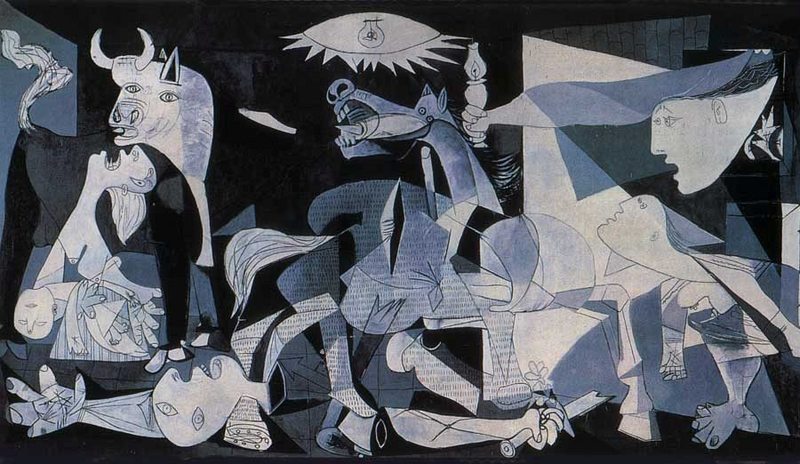
In February of 1981 I saw Pablo Picasso’s “Guernica” with my then-11-year-old daughter. When the Museum of Modern Art’s elevator doors opened the sight of the 25-foot wide masterpiece was so stunning the doors began to close before the spell was broken.
Picasso's “Guernica”

A few months later, upon the 100-year anniversary of Picasso’s birth, history’s most celebrated piece of anti-war art was packed up and sent to the Reina Sofia Museum in Madrid, Spain. However, a large copy of “Guernica” hangs on the second floor of the United Nations building -- a tapestry donated to the U.N. by Nelson Rockefeller’s estate in 1985.

On the occasion of then-Secretary of State Colin L. Powell’s February 5, 2003 presentation -- underlining his president’s impatience with U.N. members seeking to avoid, or delay, war in Iraq -- the tapestry was completely covered that day by a blue drape. Powell apparently realized that even a replica of that particular piece had to be avoided as a backdrop of any photographs of him on that fateful day.

Now nearly five years into the war-of-choice in Iraq, when I think of what has already been uncovered by investigations into the run-up to the invasion, I wonder how much of what Powell said that day he knew then had been ginned up by propagandists in the Bush administration. And, I wonder how much of what he said he believed was true.

*

In some ways little has changed at the heart of arguments concerning war and occupation since France’s army -- as driven by the empire-building vision of Napoleon Bonaparte -- was an occupying force in Spain.

Overwhelmed by the brutality of France’s campaign of terror to crush the Spanish will to resist, Francisco Goya (1746-1828) -- a well-connected artist who had much to lose -- took it upon himself to remove the romantic veil of glory which had always been draped over paintings of war in European art. Documenting what he saw of war, firsthand, the images Goya hurled at viewers of his paintings and prints radically departed from tradition.

Instead of heroic glorification Goya offered horrific gore. The art world hasn’t been the same since.

Following in Goya’s footsteps artists such as Honore Daumier (1808-1879), Georges Rouault (1871-1959), Frans Masereel (1889-1971), Otto Dix (1892-1969), among many others, created still more haunting images illustrating the grittier aspects of modern war. In the midst of the Spanish Civil War, with the storm clouds of World War II gathering, Spaniard Pablo Picasso (1881-1973) created “Guernica.”

On April 27, 1937, to field test state-of the-art equipment, Adolf Hitler loaned a portion of Germany’s air force, the Condor Legion, to a fellow fascist dictator -- Spain’s Francisco Franco. The mission: to bomb a small town a few miles inland from the Gulf of Biscay; a Basque village that had no strategic value whatsoever.

The result: utter terror.

Bombs rained on Guernica for over three hours; cold-blooded machine gunners mowed down the poor souls who fled into the surrounding fields.

Four days later with grim photographs of mutilated corpses on the front pages of French newspapers a million outraged Parisians took to their streets to protest the bombing of Guernica.

That same day Picasso, who was in Paris, dropped everything else and began sketching studies for what became “Guernica.” As Spain’s government-in-exile had already commissioned him to create a mural for its pavilion in the upcoming Paris World’s Fair, the inspired artist already had the perfect place to exhibit his statement -- a shades-of-gray, cartoonish composition made up of a terrified huddle of people and animals.

When the fair closed “Guernica” needed a home. Not only was the Spain of Generalissimo Franco out of the question, Picasso decided it wouldn’t be safe anywhere in Europe. He was probably right. Thus, the huge canvas was shipped to the USA and eventually wound up calling MOMA its home until 1981.

*

Colin Powell, a former four-star general, who, unlike some of Bush’s hawkish neoconservative experts, knew war firsthand, from the inside out. It seems the Secretary knew something about art history, as well. Six weeks before the invasion of Iraq, he apparently retained a firm grasp on the potential of “Guernica” to cast a bitterly ironic light upon his history-making utterances.

That, while he may have lost his grip on what had been his honor. Instead of resigning because he disagreed with the Bush policy, Powell said, “We also have satellite photos that indicate that banned materials have recently been moved from a number of Iraqi weapons of mass destruction facilities...”

Now Powell lives with the memory of the strategic blue drape that was thrown over “Guernica,” and the symbolic blue drape that he helped to throw over the truth.

-- 30 --

Tuesday, November 27, 2007

The Crabfolder

By F.T. Rea

Carlos Runcie Tanaka, a Peruvian sculptor of what one brief biography called, “of mixed Japanese and European ancestry,” is a star in the international art world. As it happened Mr. Tanaka was in Richmond’s Fan District for a few days in April of 2001.

Let me tell you, after watching the sculptor fold and crease a piece of paper in a local bar, I’ve got two words of advice for him -- Show Business. This concept would combine the origami with Tanaka’s considerable talent for yarn-spinning.

OK, maybe I’m getting a bit ahead of myself. Like so many tales, this one began with Happy Hour:

The Baja Bean is a Fan District watering hole located in the basement of what was originally a schoolhouse. The building itself is a stone and brick fortress. It was a typical crowd of mid-week regulars -- there were about 20 decidedly adult faces around the three-sided, horseshoe-shaped bar. The group was approximately equal parts white collar, blue color and no collar.

When then-chairman of Virginia Commonwealth University’s sculpture department Joe Seipel came in the room, with Carlos Tanaka at his side, Joe was smiling more broadly than usual. Seipel, who enjoys telling a good story, maybe even more loves to present a cool visiting artist to his pals at Happy Hour. It’s a tradition left over from the Texas-Wisconsin Border CafĂ© (1982-99), the nearby much-missed saloon which Seipel himself once co-owned. Seipel introduced Carlos to those who hadn’t already met him.

Tanaka has done much traveling, owing to his acclaim as an artist. At an art confab somewhere in South America he had met and gotten to know Seipel, plus a couple of other art faculty types at VCU’s world renown fine arts school. Then they arranged for him to come to the art school here as a visiting artist/scholar. That’s how a Peruvian artist ends up in the Bean at beer-thirty.

As an aside, Tanaka was among the hostages taken by the Tupac Amaru in that bizarre 1996 incident in Lima, Peru, at the Japanese ambassador’s home. Nonetheless, his experience as the hostage of hell-bent terrorists for 50 days apparently did nothing to diminish his overall sense of humor.

Eventually, someone asked him about the crab-folding thing.

Bingo!

Someone else supplied a blank sheet of paper. For the next 20 minutes Tanaka told stories, made observations, ad-libbed and entertained everyone on hand. Nothing else was happening in the room for that spell. The product was an intricate paper crab made from an ordinary piece of white bond paper.

Looking at the crab was fun; it almost seemed cute, for a crab. But watching the artist fold the paper, over and over -- each fold exactly where it had to be -- as he offered his lighthearted patter, like a pro, was a rare treat. To the delight of the person who had supplied the sheet of paper, the crab-folder gave it to them.

Of course, someone else had to have one, too. Then another. Tanaka must have folded four or five paper crabs that afternoon. He never ran out of offbeat stories about drinking, playing practical jokes, making art, fools in high places, and so forth. By the way, the upbeat Tanaka never mentioned the dark time he was a hostage. I found out about that later.

The next time I saw Carlos in the Bean, a couple of days later, he gave me a paper crab as a souvenir (as shown above). Soon afterward he went back to Peru. As he’d been away from his studio for months, traveling and lecturing, the artist had said he was glad to be going home. I haven’t seen him since.

Occasionally I do see Tanaka’s name associated with a big art happening in South America or Europe. A couple of years ago he did his visiting sage routine at the University of Cincinnati.

So, what’s that “mixed ancestry” business mean?

It seems one of Tanaka’s grandfathers was British, the other was Japanese. Both men married Peruvian women.

Anyway, whenever Carlos is ready to take a break from the sculpture gig, I still say a career in Show Biz as a crab-folding monologist awaits.

No doubt, I’ve spent too many of my personal allotment of hours in bars. Although it’s easy to say most of them were wasted, every now and then something genuinely unusual has happened, out of the blue, that makes me say, “I’m glad I was there.”

If nothing else those times provide fodder for a story to tell at a subsequent Happy Hour. Like our ancestors we listen and observe, so we can tell stories about what seemed unusual.

Later today, after a round of Frisbee-golf, I’ll hoist a Happy Hour beer to the time the crab-folding monologist from Peru held court in the Baja Bean in a fashion unduplicated since.

To see a gallery of Tanaka's work click here.

-- 30 --

Monday, November 26, 2007

The Price of Free Speech

By F.T. Rea
Given that in Richmond the proper meaning of the words and deeds of Robert E. Lee (1807-1870) is still hotly debated, the stately Lee Monument has been a lightning rod of sorts over the years, as well as a tourist attraction. In April the Sons of Confederate Veterans paraded by the statue on foot, on horses, on motorcycles, and on…

On a pretty morning several summers ago a curious commotion was underway about the statue’s pedestal. About 25 adults were milling about purposely; some were propping large posters against the monument itself. Upon closer examination the posters proved to be pro-life propaganda. It was the same sort of designed-to-disgust material displayed relentlessly by demonstrators outside the Women’s Clinic on the Boulevard for years.

So, why would anti-abortion activists be rallying in the shadow of a piece of heroic sculpture that fondly remembers a Confederate general mounted on his horse? Baffled, this scribbler’s curiosity got the best of him.

To get a better look, I continued walking toward the proceedings. In response to my inquiry it was explained they were there to picket an “abortionist” with an office in the medical office building, just across the street. Well, OK…

Then, with that mission accomplished, the group had opted to take some keepsake photographs, using the oldest of Monument Avenue’s statues — it was dedicated in 1890 — as a backdrop.

Standing next to identical placards displaying a blown-up depiction of a bloody fetus — at first it looked like an undercooked hamburger that had fallen off the grill — they posed with easy smiles; it could have been a company picnic or a class reunion.

On a one-to-ten scale, in the Absurd Postmodern Juxtapositions category, this business was easily a nine. Old General Lee — whose view on abortion is not widely known — he did not flinch.

A year or two before this morning a group of a similar ilk had set itself up on the grassy, tree-lined median strip, a half-block to the east. On this occasion they were there to use the funeral of Associate Supreme Court Justice Lewis F. Powell, Jr. at Grace Covenant Presbyterian Church to suit their purpose. Along with a large contingent of the working press and dozens of uniformed police officers, they waited for the funeral underway to end.

Inside the church Chief Justice William H. Rehnquist delivered the eulogy, “…[Powell] was the very embodiment of judicial temperament; receptive to the ideas of his colleagues, fair to the parties to the case, but ultimately relying on his own seasoned judgment.”

Outside the church the eager TV crews had their cameras and microphones at the ready. The patient cops had their night sticks and side arms close at hand. The lathered up news-makers brandished their oozing fetus signs and posters citing Powell as a “murderer.”

When Powell’s family, friends and Supreme Court colleagues came outside, following the service, they had no choice but to notice the demonstration before them. Lenses zoomed in to focus on their stunned reactions.

As a longtime admirer of Lewis Powell, when I saw that one of the ranting pro-lifers was wearing a clerical collar, my curiosity got the best of me then, too. So I walked over to ask him something like — was he really a man of the cloth, or was it just a shirt?

Taking umbrage, he fired back at me something about Powell having killed millions of babies. I had to assume he was referring to Powell’s role in the famous Roe vs. Wade decision. Asked what that had to do with forcing the dead judge’s family look at his gross placard, the sweaty zealot huffed and puffed.

Instead of answering the question he repeated the same blustery charge against Powell.

There you have it — free speech isn’t always pretty. In practice, the first amendment means we all have to take turns putting up with people who seem twisted, even unnecessarily mean, to us.

It’s difficult to imagine the demonstrators at Powell’s funeral changed any minds on the abortion issue by creating such a disturbing sight in the middle of the street. No, I’d say they were chiefly interested in venting their collective spleen, and in dealing out some payback.

They weren’t there to persuade. They were there to punish and strike fear in the hearts of anyone who dares to rub them the wrong way.

Still, in our optimistic and open society we are obliged to tolerate such uncouth venting. Let’s not forget that popular speech has never needed much protection at any time in history.

OK, that’s the price of free speech. Pose however you like next to the statue of old General Lee, astride Traveler. Wear funny costumes, bring props. As long as you don’t want to stand in my yard, in order to push your ideas — twisted or not — go for it.

Short of what might constitute an assault, we all have the basic right to express ourselves. Pretty or not, your freedom to comment is part of the deal, the American deal.

Alas, Lee won’t flinch … even if I do.

-- 30 --

Tuesday, October 30, 2007

Sign of the Times


One summer afternoon in the mid-1970s, I was walking about 20 yards behind a guy heading east on the 800 block of West Grace Street. Then, like it was his, he casually picked up the Organic Food Store’s hand-painted sandwich board style sign from the sidewalk in front of the store.

Without even looking around for any witnesses to his act of dishonesty the sign thief kept going at the same pace.

As I walked faster to close the distance between us we continued down the red brick sidewalk. By the time we had passed the Biograph Theatre, where I worked, I had sized him up and decided what I would do. He was a big-haired hippie, 18 to 20 years old; he could have been a student. Or, he might have been a traveling panhandler/opportunist. In those days there were plenty of both in the neighborhood.

Passing by Sally Bell’s Kitchen, in the 700 block, I was within six or seven yards of him when I spoke the lines I had written for myself while walking. My tone was resolute, my voice clear: “Hey, I saw you steal the sign. Don’t turn around … just put it down and walk away.”

The thief’s body language announced that he had heard me, but he didn’t turn around. Instead he walked faster, with the sign under his right arm, holding the weight with his hand.

Moving closer to him, I said with more force: “Put the sign down. The cops are on the way. Walk away while you still can.”

Without further ado the wooden sign clattered onto the sidewalk. The sign thief kept going without looking back. As I gathered my neighbor’s property I watched the fleeing hippie break into a sprint, cross Grace Street and disappear going toward Monroe Park at the next corner.

Then I carried the recovered property back to the store, which was a few doors west of the Biograph. Obviously, I don’t really remember exactly what I said to the thief over three decades ago, verbatim, but that was a faithful recounting of the events.

What I had done came in part from a young man’s sense of righteous indignation, together with the spirit of camaraderie that existed among some of the neighborhood’s merchants in that time. There were several of us, then in our mid-to-late-20s, who were running businesses on that bohemian strip — bars, retail shops, etc. We were friends and we watched out for one another.

Now I’m amazed that I used to do such things. My tough guy performance had lasted less than a minute. The character I invented was drawn somewhat from Humphrey Bogart, with as much Robert Mitchum as I could muster. Hey, the thief must have felt lucky to get away.

Who knows? Maybe he’s still telling this same story, too, but from another angle.

This much I know — that quirky pop scene on Grace Street in those days was a goldmine of offbeat stories. Chelf’s Drug Store was at the corner of Grace and Shafer. With its antique soda fountain and a few booths, it had been a hangout for magazine-reading, alienated art students since the late-1940s. It seemed frozen in time.

The original Village Restaurant, a block west of Chelf’s, was a legendary beatnik watering hole, going back to the 1950s. Writer Tom Robbins and artist William Fletcher “Bill” Jones (1930-‘98) hung out there. Strangely, that location has remained boarded up for decades, while the new Village still goes on across Harrison Street. That same neighborhood was also home to cartoon-like characters such as the wandering Flashlight Lady and the Grace Street Midget.

During the late-‘60s the hippies had come on strong to replace the beats, as the strip went psychedelic, seemingly overnight. But by the mid-‘70s the hippie blue jean culture had peaked. It was about to be replaced by the black leather of Punk Rock and polyester of the Disco scene. All-night dance clubs became popular.

So, by the late-‘70s the mood on the strip had changed severely. Cocaine was becoming the preferred drug of choice with the druggie in-crowd, replacing pot. Several restaurants were serving liquor-by-the-drink, the dives catering to the young set began having rugged bouncers at the door.

Into the ‘80s I remember an angry, red-bearded street beggar with a missing foot threatening to “bite a plug out” of me, because I had had the temerity to tell him to stop bothering people in front of the Biograph, to move on.

In that moment it was painfully obvious to me that times had indeed changed. Wisely, I didn’t press my case any further that day. Instead, I moved on.


-- 30 --

All rights reserved by the author. 

Tuesday, September 19, 2006

Unplugged: Waking Up the Day After

By F.T. Rea

On the Friday morning after Hurricane Isabel blew through town (Sept. 19, 2003), the sky was blue and the air smelled clean. The residents of the Fan District, at the heart of Richmond, Va., woke from an uneasy sleep. Day One of the unplugged life was underway.

Before the worst of the storm passed, about midnight, Isabel tossed huge trees around like a handful of pickup sticks. Power lines snapped. Cars were crushed. Roofs caved in and basements flooded. As the shocking devastation dealt out by the previous night’s onslaught of wind and rain was revealed to the stunned urbanites in the Fan, so too did the reality of widespread electricity deprivation.

Still, faced with all sorts of uncertainty and disconnected from the doings in the rest of the world, many wandering the streets like zombies on that morning faced the immediate problem that there was no hot coffee to be had.

For hundreds of his neighbors, Manny Mendez, owner of Kuba Kuba, took care of the coffee shortage on that surreal morning. Boiling water on the restaurant’s gas stove and pouring it over sacks (improvised coffee filters) in a big colander, Mendez and his staff doled out tasty Cuban coffee to anyone who stopped by.

While opportunists in other parts of town were marking up prices on candles, batteries, ice, generators and anything else for which the supply was short and the demand was great, Kuba Kuba was pouring strong coffee for one and all at no charge — free!

“What are we going to do [under these circumstances], charge people for coffee?” Mendez asked rhetorically with a shrug.When word got around that Kuba Kuba — at Park Avenue and Lombardy Street — had hot coffee, the crowd on the sidewalk outside the small restaurant swelled. Into the afternoon the size of the gathering fluctuated between 20 and 40 people at a time. Many neighbors met for the first time. By the time the coffee-making effort shut down in mid-afternoon, 100 gallons of free coffee had been served in paper cups.

By then several of Manny’s tables were on the sidewalk, with chairs arranged around them. Out came the boxes of dominoes.

The marathon dominoes scene continued for hours under the lights of a borrowed generator. Players sat in for a while, then sat out. Neighbors appeared with what they had in the way of libation. They swapped stories and the laughter from what had become an impromptu party drove off the demons that lurked in the eerie darkness, only 50 yards away.

Dominoes shark Manny Mendez was all of 6 years old when he boarded an airplane with a one-way ticket to a totally uncertain future in the United States. In 1968, for people such as the Mendez family, getting out of Cuba was worth the risk of fleeing into the unknown.

The day little Manny left Cuba, his father was thought to be in Spain, as he had been deported. His mother was crestfallen when told that there were no flights going to Spain on the day her family was offered its chance to flee what Cuba had become. Recently released from 13 months of confinement at an agricultural labor colony, she opted to board the Red Cross-sponsored Freedom Flight for wherever it was going.

On Aug. 2, 1968, that airplane took Judith Mendez and her two children, Manny and his sister, Judy, away from Cuba. It landed in Florida. Upon touching down, Judith Mendez called her relatives, who lived in Richmond, to tell them the good news.

To her surprise she was told her husband, Manuel, was already in Richmond.

After a spell in an apartment building at Harrison Street and Park Avenue, the Mendez family moved to the 3400 block of Cutshaw Avenue, where several other Cuban families had settled. There was one car, a ’56 Chevy owned by his uncle, for the whole group to share.

Manny’s father had been an accountant in Cuba; in Richmond his first job title was “janitor.” As time passed, Manuel Mendez improved his situation and became a leader of the growing Cuban community in Richmond by making regular trips to Washington, D.C., to buy the essentials for Latin cooking and other imported goods unavailable in Richmond.

“Papi, how often did we used to lose power in Cuba?” Manny asked of his father during one of the dominoes games.

In his distinctive accent, with the timing of a polished raconteur, Manny’s father rolled the “r” as he said, “Oh, about two or three times … a night!”

Those gathered laughed, having seen a glimpse of a wider perspective about coping with bad luck. Manny’s mother and the Cuban employees of Kuba Kuba laughed the loudest. Then, too, that may account for why Kuba Kuba routinely carries candles for sale along with other sundries.

The dominoes party broke up about 1:30 a.m. Most of the crowd returned to homes without power — with strange noises in the anxious quiet — no televisions, no Internet, and refrigerators full of risky food. No doubt, some of the dominoes players carried away from that night a new appreciation for people who can handle hardship with grace. Some may have even gained new insight into how it must be in places where millions do without power, in one way or another, most of the time.

-- 30 --

Tuesday, August 30, 2005

The Cheaters


by F. T. Rea

Having devoted countless hours to competitive sports and games of all sorts, nothing in that realm is quite as galling to this grizzled scribbler as the cheater’s averted eye of denial, or the practiced tones of his shameless spiel.

In the middle of a pick-up basketball game, or a friendly Frisbee-golf round, too often, my barbed outspokenness over what I have perceived as deliberate cheating has ruffled feathers. Alas, it's my nature. I can't help it any more than a watchful blue jay can resist dive-bombing an alley cat.

The reader might wonder about whether I'm overcompensating for dishonest aspects of myself, or if I could be dwelling on memories of feeling cheated out of something dear.

OK, fair enough, I don't deny any of that. Still, truth be told, it mostly goes back to a particular afternoon's mischief gone wrong.

*

A blue-collar architect with the Chesapeake & Ohio Railway for decades, my maternal grandfather, Frank Wingo Owen was a natural entertainer. Blessed with a resonant baritone/bass voice, he began singing professionally in his teens and continued performing, as a soloist and with barbershop quartets, into his mid-60s.

Shortly after his retirement, at 65, the lifelong grip on good health he had enjoyed failed; an infection he picked up during a routine hernia surgery at a VA hospital nearly killed him. It left him with no sense of touch in his extremities. Once he got some of his strength back, he found comfort in returning to his role as umpire of the baseball games played in his yard by the neighborhood's boys. He couldn't stand up behind home plate, anymore, but he did alright sitting in the shade of the plum tree, some 25 feet away.

This was the summer he taught me, along with a few of my friends, the fundamentals of poker. To learn the game we didn’t play for real money. Each player got so many poker chips. If his chips ran out, he became a spectator.

The poker professor said he’d never let us beat him, claiming he owed it to the game itself to win if he could, which he always did. Woven throughout his lessons on betting strategy were stories about poker hands and football games from his cavalry days, serving with the Richmond Blues during World War I.

As likely as not, the stories he told would end up underlining points he saw as standards: He challenged us to expose the true coward at the heart of every bully. "Punch him in the nose," he'd chuckle, "and even if you get whipped he'll never bother you again." In team sports, the success of the team trumped all else. Moreover, withholding one’s best effort in any game, no matter the score, was beyond the pale.

Such lazy afternoons came and went so easily that summer there was no way then, at 11, I could have appreciated how precious they would seem looking back on them.

On the other hand, there were occasions he would make it tough on me. Especially when he spotted a boy breaking the yard's rules or playing dirty. It was more than a little embarrassing when he would wave his cane and bellow his rulings. For flagrant violations, or protesting his call too much, he barred the guilty boy from the yard for a day or two.

F. W. Owen’s hard-edged opinions about fair play, and looking directly in the eye at whatever comes along, were not particularly modern. Nor were they always easy for know-it-all adolescent boys to swallow.

Predictably, the day came when a plot was hatched. We decided to see if artful subterfuge could beat him at poker just once. The conspirators practiced in secret for hours, passing cards under the table with bare feet and developing signals. It was accepted that we would not get away with it for long, but to pull it off for a few hands would be pure fun.

Following baseball, with the post-game watermelon consumed, I fetched the cards and chips. Then the four card sharks moved in to put the caper in play.

To our amazement, the plan went off smoothly. After hands of what we saw as sly tricks we went blatant, expecting/needing to get caught, so we could gloat over having tricked the great master. Later, as he told the boys' favorite story -- the one about a Spanish women who bit him on the arm at a train station in France -- one-eyed jacks tucked between dirty toes were being passed under the table.

Then the joy began to drain out of the adventure rapidly. With semi-secret gestures I called the ruse off. A couple of hands were played with no shenanigans but he ran out of chips, anyway.

Head bowed, he sighed, “Today I can’t win for loosing; you boys are just too good for me.” Utterly dependent on his cane for balance he slowly walked into the shadows toward the back porch. It was agonizing.

The game was over; we were no longer pranksters. We were cheaters.

As he carefully negotiated the steps, my last chance to save the day came and went without a syllable out of me to set the record straight. It was hard to believe that he hadn’t seen what we were doing, but my guilt burned so deeply I didn't wonder enough about that, then.

*

My grandfather didn’t play poker with us again. He went on umpiring, and telling his salty stories afterwards over watermelon. We tried playing poker the same way without him, but it didn’t work; the value the chips had magically represented was gone. The boys had outgrown poker without real money on the line.

Although I thought about that afternoon's shame many times before he died nine years later, neither of us ever mentioned it. For my part, when I tried to bring it up, to clear the air, the words always stuck in my throat.

Eventually, I grew to become as intolerant of petty cheating as he was in his day, maybe even more so. And, as it was for him, the blue jay has always been my favorite bird.

-- 30 --